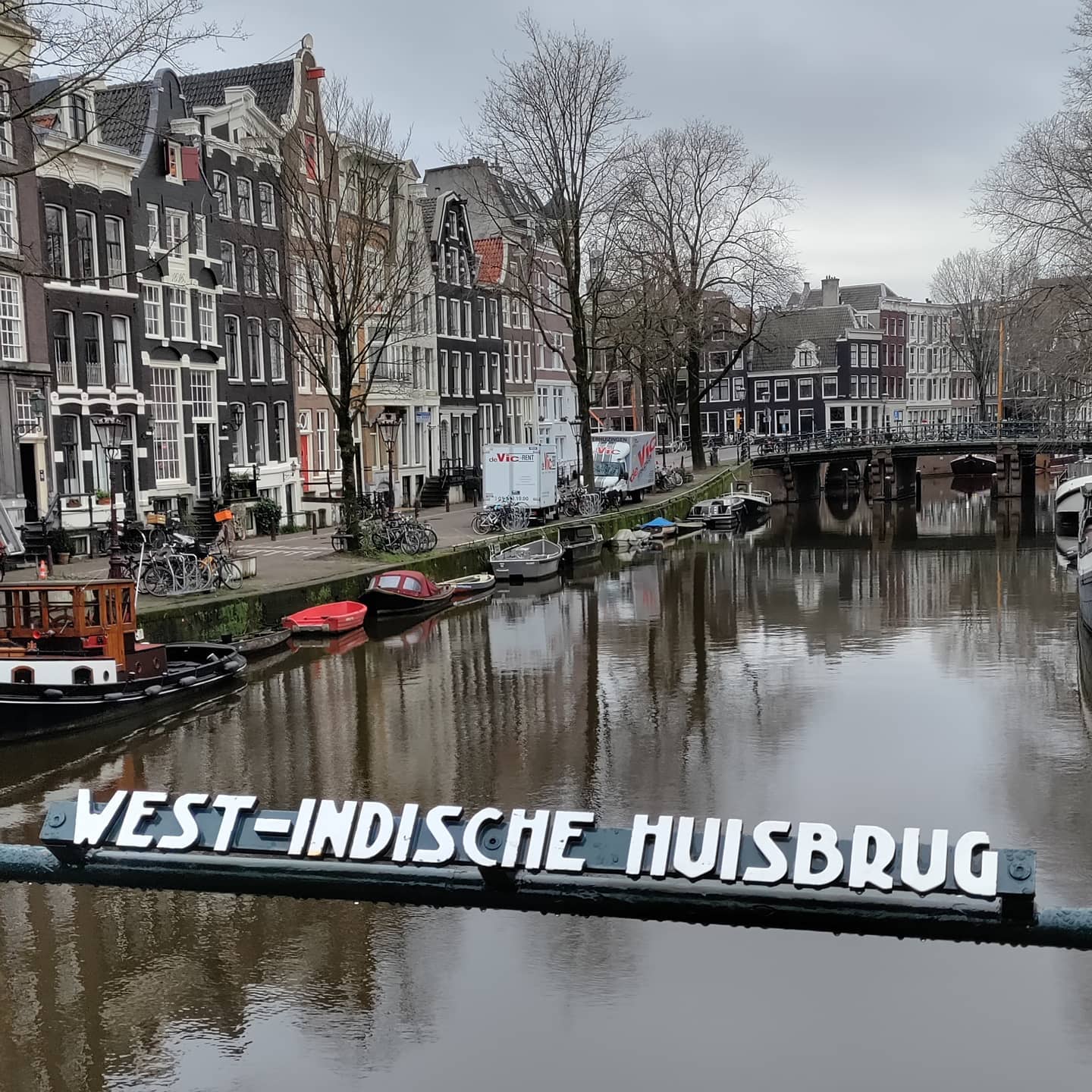
West Indian house bridge – Brug 17
This bridge connects the western quay of the Herengracht with the Herenmarkt and crosses the Brouwersgracht. There is also a bridge over the Brouwersgracht in the eastern quay of the Herengracht the Melkmeisjesbrug (Bridhe 16). Although there is no bridge over the Herengracht itself here which can make journey planning awkward. The bridge is surrounded by municipal and national monuments. The West-Indisch Huis it is named after is a rijksmonument; the bridge itself has been a gemeentelijk monument since 1995. In April 2016, the bridge was in the Amsterdam news as the municipality decided at the time that bridges that only had an unofficial name in addition to their number, would lose that name. This bridge was accidentally on the list of bridges without an official name.


The Bridge of Two Indies: Unravelling the Secrets of the West-Indische Huisbrug
At the head of the Herengracht, where Amsterdam’s most elegant canal meets the historic Brouwersgracht, a quiet architectural anomaly stands sentinel. This is the West-Indische huisbrug (Bridge 17), a structure that refuses to conform to type. It is part arch, part beam bridge, a hybrid form that mirrors the complex history of the ground it touches. But its name points to something far grander: the West-Indisch Huis, the headquarters of the Dutch West India Company, a building from which admirals once planned voyages that would shape the Atlantic world. To stand on this bridge is to stand at the crossroads of Dutch colonial history and municipal engineering.
A Name Etched in Colonial History: The West-Indisch Huis
The bridge’s name is its most direct historical statement: it is the bridge of the West India House. The West-Indisch Huis, a sprawling complex just steps away on the Herenmarkt, was the Amsterdam chamber of the Geoctroyeerde West-Indische Compagnie (Chartered West India Company), founded in 1621. From this very neighborhood, ships were dispatched to Brazil, the Caribbean and New Netherland, the colony that would one day become New York. Figures like Piet Heyn, who captured the Spanish Silver Fleet and Wouter van Twiller, a director of New Netherland, walked the streets around this bridge.
The bridge, therefore, is not named for a trade or a local landmark in the abstract, but for a specific, powerful institution whose physical presence still dominates the western end of the Herenmarkt. It is a rare example in Amsterdam of a bridge named directly for a company headquarters, a testament to the immense influence the WIC once wielded in this corner of the city. The building itself, now used for events and offices, is a rijksmonument (national monument) and its proximity elevates this simple crossing into a piece of living history.
From Wooden Draw to Stone Hybrid: A Structural Evolution
Like its neighbor, the Melkmeisjesbrug, a crossing at this point is ancient. The great cartographers of the 17th century, Van Berckenrode (1625), Blaeu (1649) and Stalpaert (1662) , all show a bridge here . For centuries, it would have been a wooden drawbridge, allowing ships with masts to pass from the Brouwersgracht into the Herengracht, serving the warehouses and the West India Company’s own wharves.
The first major shift came in 1879 and it is intimately tied to the story of Brug 15. As the Wikipedia article notes, the decision to make Brug 15 a fixed bridge was possible because Brug 17 was already a fixed arch bridge . By this time, seagoing vessels no longer penetrated this far into the city center. The age of sail had given way to steam and larger ships that docked elsewhere. The entire northern Canal Belt was transitioning from a working waterfront to a residential and storage district.
The real transformation, however, came in 1900. By the late 1890s, the existing arch bridge was in poor condition. In 1898, it became a matter of public debate. The city acknowledged the need for renewal but pleaded poverty, a familiar refrain in municipal politics. They gambled that the traffic disruption could be tolerated . By March 1900, the city had found the funds, a substantial sum of 28,500 guilders . The work began with pile-driving that took half a year and by November 1900, the new bridge was ready to open .
This 1900 structure is the bridge we cross today. It was designed by the Dienst der Publieke Werken (the Public Works Department), the anonymous but highly skilled municipal service that shaped so much of Amsterdam’s infrastructure .
An Architectural Anomaly: The Hybrid Design of Publieke Werken
This is where the West-Indische huisbrug reveals its true character. It is not a pure example of any single style. Instead, it is a pragmatic and visually striking hybrid. As the Wikipedia article describes, it has “aan beide landhoofden bogen, terwijl het midden van de brug gekozen is voor een liggerbrug” (arches at both abutments, while the middle of the bridge is a girder bridge) .
This combination of a welfbrug (arch bridge) and a liggerbrug (girder bridge) is unusual. The brick arches at either end, faced with graniet (granite) , ground the bridge visually in the masonry traditions of the 17th century, nodding to the old warehouses around it. But the central span, an iron girder structure, speaks to the modern engineering of 1900. It is a bridge in transition, both literally and stylistically.
There are no flourishes here that would mark it as the work of a later artist like Piet Kramer. No sculpted figures, no whimsical ironwork. This is the work of an engineer at Publieke Werken who prioritized a solid, functional crossing that could handle the traffic of the day while harmonizing with its monumental neighbors. The result is a bridge of quiet dignity, its strength lying in its clear, logical form and the honest use of materials: warm brick, cool granite and industrial iron.
The Herenmarkt and the Shadow of the Company: Urban Context
The bridge’s location is its second great story. It connects the western quay of the Herengracht to the Herenmarkt (Gentlemen’s Square). This small, hidden square is one of Amsterdam’s most atmospheric spaces, dominated by the massive facade of the West-Indisch Huis. For centuries, this was a place of immense activity, where sailors were hired, cargo was insured and news from the colonies was first received.
Today, the bridge functions as a quiet pedestrian and cyclist route, linking the bustle of the Brouwersgracht to the tranquility of the Herenmarkt. It offers no grand, sweeping view like the Melkmeisjesbrug, but rather a more intimate perspective: a glimpse of a hidden square, a view of historic warehouses, a sense of stepping back in time. It is surrounded by a constellation of gemeentelijke en rijksmonumenten (municipal and national monuments), making every direction a study in preserved history.
Technical Details and a Modern Naming Controversy
- Type: Vaste brug (Fixed bridge). A hybrid of an arch bridge (welfbrug) at the abutments and a girder bridge (liggerbrug) for the central span.
- Materials: Baksteen (brick) for the arches, graniet (granite) for the facing and details and ijzer (iron) for the central girder structure.
- Modifications: In 1980, the roadway over the side passages had to be reinforced, a minor but necessary intervention to keep the bridge serving its community.
A fascinating modern footnote occurred in 2016. The city, in a bureaucratic audit, mistakenly listed the bridge as having only an unofficial name, putting it at risk of being renamed. The youth wing of a political party, the JOVD, saw an opportunity and proposed naming it after the recently deceased politician Hans van Mierlo, who had lived nearby. The proposal triggered a correction from the city: the name West-Indische huisbrug was and had always been, its official name. The Hans van Mierlo name was instead given to another bridge, Brug 18 . This small controversy highlights how deeply these names matter, how they anchor our sense of place and history.
In conclusion, the West-Indische huisbrug is a bridge of layers. Look at its form and you see the pragmatic genius of 1900’s Publieke Werken. Look at its name and you confront the vast, complex history of the Dutch Atlantic empire. Stand on it and you are at the meeting point of a grand canal, a hidden square and four centuries of Amsterdam life. It is a bridge that asks you to look closer, to dig deeper and to remember.
Sources and Further Reading
Primary Sources & Archival References
- Stadsarchief Amsterdam (Amsterdam City Archives)
- Archief van de Publieke Werken (Public Works Department archives), dossier 13017 betreffende de vernieuwing van brug 17, 1900. (Centraal Tekeningen Archief).
- Bouw- en vergunningstekeningen (Building and permit drawings) for the 1900 bridge reconstruction.
- Cartographic Sources
- Florisz. van Berckenrode, Balthasar (1625). Kaart van Amsterdam. Stadsarchief Amsterdam.
- Blaeu, Joan (1649). Atlas Maior, map of Amsterdam.
- Stalpaert, Daniël (1662). Nieuwe kaarte van de stede Amsterdam. Stadsarchief Amsterdam.
- Municipal Registries
- Basisregistratie Adressen en Gebouwen (BAG), gemeente Amsterdam. Entry for West-Indische Huisbrug.
- Gemeentelijk Monumentenregister (Municipal Monument Registry), entry for Brug 17 (since 1995).
- Rijksmonumentenregister (National Monument Registry), entry for het West-Indisch Huis (Herenmarkt 99).
Online Databases & Historical Websites
- Wikipedia contributors. (2022, July 26). “West-Indische huisbrug.” Wikipedia, De vrije encyclopedie. https://nl.wikipedia.org/wiki/West-Indische_huisbrug
- Korrel, Peter. “Brug 17: West-Indische Huisbrug.” Bruggen van Amsterdam. https://bruggenvanamsterdam.nl/herengracht_hoek_brouwersgracht.htm (Accessed 26 July 2022).
- Wikipedia contributors. “West-Indisch Huis (Amsterdam).” Wikipedia, De vrije encyclopedie.
- Wikipedia contributors. “Brouwersgracht.” Wikipedia, De vrije encyclopedie.
- data.amsterdam.nl. Entry for West-Indische Huisbrug via Basisregistratie Adressen en Gebouwen (BAG).
Historical Context & Further Reading
- Mak, Geert. (1995). Een kleine geschiedenis van Amsterdam. Uitgeverij Atlas. (Essential for understanding Amsterdam’s Golden Age and the role of trading companies).
- Gawronski, J., & Veenman, R. (2018). *De Amsterdamse bruggen: Bouw en ontwikkeling 1850-1950*. Uitgeverij Thoth. (For context on Publieke Werken and bridge engineering at the turn of the century).
- Schama, Simon. (1987). The Embarrassment of Riches: An Interpretation of Dutch Culture in the Golden Age. (Provides deep cultural context for the institutions like the WIC).
- Den Heijer, Henk. (2013). De geschiedenis van de WIC. Walburg Pers. (Definitive history of the Dutch West India Company).
- Nu.nl. (2016). News articles regarding the Hans van Mierlo naming controversy. (Referenced in Wikipedia article).
Image Collections
- Wikimedia Commons. “Categorie: Brug 17, West-Indische Huisbrug.” https://commons.wikimedia.org/wiki/Category:Brug_17,_West-Indische_Huisbrug
- Beeldbank Stadsarchief Amsterdam. Photographs of the West-Indische huisbrug, the West-Indisch Huis and the Herenmarkt, various dates 1880-present. https://archief.amsterdam/beeldbank/

Brug Zeventien connects the western quay of the Herengracht with the Herenmarkt and crosses the Brouwersgracht. The eastern quay has a pedestrian bridge across the Brouwersgracht in #bridge16, so we did that yesterday Melkmeisjesbrug. As you will see in the next post this bridge almost became Hans van Mierlo Bridge instead of West-Indische huisbrug in 2016 because of a clerical error.


Like many of the other bridges there has been a bridge here for centuries and again Balthasar Florisz. van Berckenrode (1625), Joan Blaeu (1649) and Daniël Stalpaert (1662) had this bridge on their maps. Since bridge 17 is a fixed arch bridge, there is no longer any need to keep bridge 15 movable, sailing ships could no longer pass through anyway. So as you saw Bridge 15 was also fixed.
In April 2016 the bridge was on the list of bridges without an official name and the JOVD proposed to name the bridge after Hans van Mierlo, who lived nearby. When the proposal was submitted, the municipal error came to light and it was put on the list of bridges with an official name, it therefore remained the West Indian house bridge.


