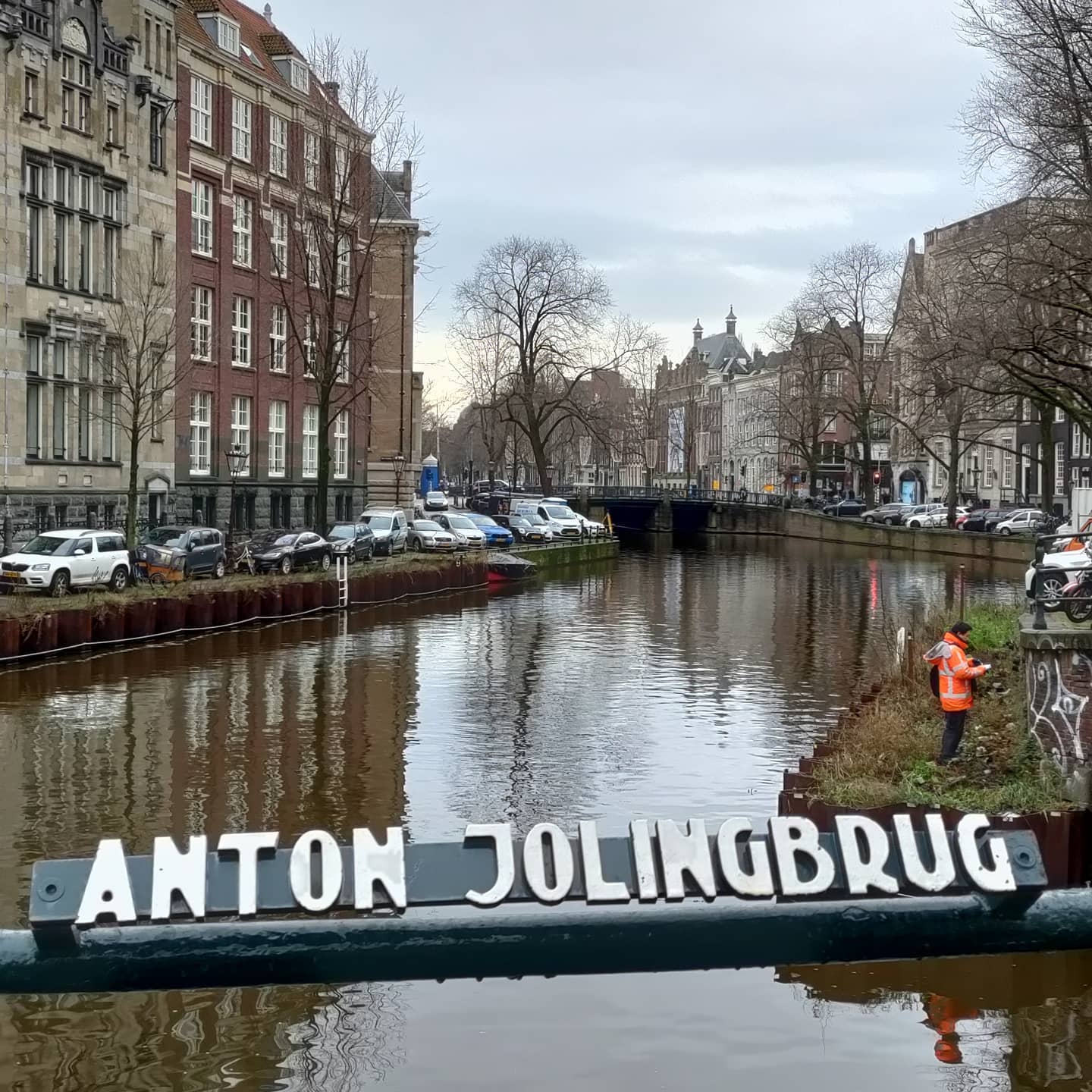
The Anton Jolingbrug is another bridge over the Herengracht. It again has been here for centuries although it was lowered and widened in 1886 along with the next bridge (21). The bridge was designated a municipal monument in 1995 and then in 2016/2017, the bridge was named after the famous architect Antonius Jacobus (Anton J.) Joling at the request of the foundation that manages the estate. If you’ve visited Amsterdam then you’ve probably seen the Peek & Cloppenburg shop on Dam Square which he designed.


The Architect’s Bridge: How Anton Joling Gave His Name to a 17th-Century Crossing
In the quiet grid of Amsterdam’s Canal District, where the Herengracht meets the Leliegracht, a subtle but significant bridge carries traffic between two worlds. To the east lies the stately grandeur of the Herengracht. To the west, the more intimate Leliegracht leads towards the Jordaan. The bridge that connects them, Brug 20, is a study in practical elegance. But its story has a final, surprising twist: in 2016, this 19th-century structure was named for a 20th-century architect, Anton Joling. It is a rare case of a bridge honoring not a politician or a painter, but one of its own kind, a master of the built environment who lived and worked in its shadow.
A Name from the Modern Era: The Anton Jolingbrug
For most of its long life, this crossing was known simply as Brug 20, a number in the municipal ledger. That changed in 2016 and 2017, when the bridge was officially named the Anton Jolingbrug . The initiative came not from the city, but from a private foundation dedicated to preserving the legacy of the architect Anton J. Joling (1902-1976) .
Joling was a respected Amsterdam architect, a figure very much in the lineage of the city’s Bouwmeesters (master builders). He was born in Zevenaar on 25 March 1857 and died in Amsterdam on 4 January 1934, so his work belongs to the decades either side of 1900 rather than to the Amsterdam School generation that followed. He was taught from the age of thirteen by an uncle who was a contractor, worked as a carpenter, came to Amsterdam at twenty as a site supervisor, and at twenty-two joined the office of Pierre Cuypers, where he spent eight years before setting up on his own at thirty. His specialisms were offices, factories, schools and hospitals. His work is characterized by a thoughtful, functionalist style that respected its surroundings. By naming this bridge after him, the foundation and the city created a subtle, daily memorial. It ensures that every person who cycles or drives across the Herengracht at this point passes over a tribute to a man who dedicated his life to shaping the city’s architecture. It is a bridge, quite literally, for an architect.
From Five Arches to a Single Span: A Structural Evolution
The history of a crossing at this exact spot is as old as the Canal District itself. The indispensable map of Balthasar Florisz. van Berckenrode from 1625 clearly shows a bridge here, depicted as a welfbrug (vault bridge) with five passages spanning the Herengracht at the Lely Graft (Leliegracht) . For over 250 years, this multi-arched stone bridge served the neighborhood, its five openings allowing water and light to pass beneath its sturdy bulk.
The great transformation came in the late 19th century, driven by two forces: the decline of sail-powered cargo traffic in the city center and the explosive growth of horse-drawn vehicles. In 1886, the city faced a dilemma. The old arched bridge was too steep and too narrow for the increasing traffic. They needed to both lower it (verlagen) and widen it (verbreden).
As the Wikipedia article notes, the city’s budget was tight. There was a genuine debate about whether spending money on this bridge was wise, given that other crossings might have greater needs . But the project went ahead. By July 1886, temporary bridges were in place and workers were demolishing the old superstructure. The work was done in tandem with the adjacent Brug 21, its partner over the Leliegracht. By early 1887, the new bridge was complete .
The 1887 bridge, designed by the engineers of the Dienst der Publieke Werken (Public Works Department) , was a masterpiece of pragmatic design. It replaced the five-arch stone bridge with a single, shallow arch. This new form was lower and flatter, much easier for horses and carts to cross. It was also wider, able to accommodate the growing flow of traffic. A photograph from around 1870 by Pieter Oosterhuis captures the old bridge just before its demolition, while modern photos show the clean, single arch of the replacement.
The Pragmatic Hand of Publieke Werken
The Anton Jolingbrug is a prime example of the work of Publieke Werken in the late 19th century, an era of functional, well-engineered infrastructure that predated the artistic flourishes of the 20th century. The 1887 design is notable for its simplicity and strength. It is a fixed bridge with a single, shallow arch of brick and stone.
There are no decorative elements here that would signal the hand of a later artist like Kramer. No sculpted granite “nose” stones, no whimsical ironwork. The beauty of this bridge lies in its clear, logical form. The single arch is elegant and uncluttered, allowing unobstructed views up and down the Herengracht. The masonry is solid and well-proportioned, a testament to the skilled masons and engineers of the day.
The bridge proved so well-built that it required no major structural changes for decades. In 1962, the bridge deck (brugdek) was renewed, and this work was done in consultation with the architect Dirk Sterenberg . Sterenberg, as we have seen with Brugs 18 and 19, was a master of historical bridge design in the mid-20th century. His involvement here was likely to ensure that the new deck respected the original 1887 design.
The quality and historical significance of the bridge were formally recognized on October 10, 1995, when it was declared a gemeentelijk monument (municipal monument) . It now holds this protected status alongside the many gemeentelijke en rijksmonumenten (municipal and national monuments) that surround it.
The Quiet Intersection: Urban Context
The Anton Jolingbrug occupies a pivotal but understated position in the Canal District. It sits at the intersection of two waterways: the Herengracht, running north-south, and the Leliegracht, running east-west. It forms a functional unit with Brug 21, which spans the Leliegracht just to the west . Together, they manage the flow of traffic between the Herengracht and the Jordaan.
The bridge’s immediate neighborhood is a rich tapestry of historic buildings. To the south, the Herengracht stretches towards the Raadhuisstraat and the bustling heart of the city. To the north, it leads towards the Brouwersgracht and the area we have explored in previous investigations. The Leliegracht, with its quiet bridges and houseboats, offers a picturesque route into the Jordaan.
Today, the Anton Jolingbrug functions as a vital verkeersbrug (traffic bridge) . It carries a steady stream of cars, cyclists, and pedestrians. It does not offer a single, world-famous viewpoint, but rather a series of intimate and charming perspectives. From its crown, you can look south down the Herengracht, or west into the Leliegracht with its own crossing, Brug 21. It is a bridge for people going places, a quiet workhorse in one of the city’s most beautiful neighborhoods.
Technical Specifications: A Monument to Function
- Type: Vaste brug (Fixed bridge). A single-arch boogbrug (arch bridge) .
- Materials: Brick and stone for the arch and abutments, with granite likely used for the water-facing elements. The deck is modern asphalt over a reinforced concrete structure (renewed in 1962).
- Architect: Dienst der Publieke Werken (1887 design), with later consultation by Dirk Sterenberg (1962).
- Current Use: Mixed traffic (vehicles, cyclists, pedestrians).
- Special Status: Gemeentelijk monument (municipal monument) since 1995.
The Anton Jolingbrug is a bridge of quiet layers. Its fabric dates from 1887, a masterwork of 19th-century engineering. Its name, added in 2016, is a tribute to a 20th-century architect who understood and respected such structures. And its origins reach back to the 17th century, when this was the edge of a booming city. It is a fitting memorial for a man who built for the future while honoring the past.
Sources and Further Reading
Primary Sources & Archival References
- Stadsarchief Amsterdam (Amsterdam City Archives)
- Archief van de Publieke Werken (Public Works Department archives), dossiers betreffende de vernieuwing van brug 20, 1886-1887.
- Archief van de Publieke Werken, dossier 40459 betreffende de vernieuwing van het brugdek van brug 20, 1962 (in overleg met Dirk Sterenberg).
- Bouw- en vergunningstekeningen (Building and permit drawings) for the 1886/1887 bridge and the 1962 deck renewal.
- Fotocollectie: Photographs by Pieter Oosterhuis, circa 1870, showing the old five-arch bridge before demolition.
- Cartographic Sources
- Florisz. van Berckenrode, Balthasar (1625). Kaart van Amsterdam. Stadsarchief Amsterdam.
- Municipal Registries & Official Documents
- Basisregistratie Adressen en Gebouwen (BAG), gemeente Amsterdam. Entry for Anton Jolingbrug via data.amsterdam.nl.
- Gemeentelijk Monumentenregister (Municipal Monument Registry), entry for Brug 20 (since 1995).
- Rijksmonumentenregister (National Monument Registry), entries for surrounding buildings.
Online Databases & Historical Websites
- Wikipedia contributors. (2022, July 27). “Anton Jolingbrug.” Wikipedia, De vrije encyclopedie. https://nl.wikipedia.org/wiki/Anton_Jolingbrug
- Korrel, Peter. “Anton Jolingbrug, brug 20 in de Leliegracht over de Herengracht.” Bruggen van Amsterdam. https://bruggenvanamsterdam.nl/ (Accessed 27 July 2022).
- data.amsterdam.nl. Entry for Anton Jolingbrug via Basisregistratie Adressen en Gebouwen (BAG).
Historical Context & Further Reading
- Gawronski, J., & Veenman, R. (2018). *De Amsterdamse bruggen: Bouw en ontwikkeling 1850-1950*. Uitgeverij Thoth. (Essential for understanding the 1886/1887 reconstruction and the role of Publieke Werken).
- Smit, Frank V. (2008). Bruggen in Amsterdam. Uitgeverij Matrijs. (Provides context on Dirk Sterenberg’s role in mid-century bridge renovations).
- Mak, Geert. (1995). Een kleine geschiedenis van Amsterdam. Uitgeverij Atlas. (For understanding the broader development of the Herengracht and Leliegracht area).
Image Collections
- Wikimedia Commons. “Categorie: Brug 20, Anton Jolingbrug.” https://commons.wikimedia.org/wiki/Category:Brug_20,_Anton_Jolingbrug
- Beeldbank Stadsarchief Amsterdam. Photographs of Brug 20 and the surrounding area, including images by Pieter Oosterhuis (circa 1870). https://archief.amsterdam/beeldbank/

The Anton Jolingbrug forms the connection between the Oude Leliestraat and the northern quay of the Leliegracht. Like many of the previous bridges this one spans the Herengracht and connects with the following bridge forming a unit with bridge 21.

The modern history of the Anton Joling bridge began in 1886. Due to declining shipping traffic coupled with increasing road traffic across the bridge, the municipality of Amsterdam examined whether the bridge could be lowered and widened. The work was started in July 1886 with temporary bridges and the old structure being demolished. Bridge 21 was also lowered and widened at the same time. The project for both was completed at the beginning of 1887. The bridge was designated a municipal monument in 1995 and then in 2016/2017 the bridge was named after the famous architect Anton J. Joling who designed amongst other things the Peek and Cloppenburg building on Amsterdam Dam Square.


