Welcome to my personal catalogue of the spans that connect Amsterdam. After exploring and photographing hundreds of the city’s 1,200+ crossings, I have curated a list of my favourite ten. This collection is not a definitive ranking, but rather a cross-section of the city’s diverse engineering and history. From iconic Golden Age draws to innovative new bicycle paths, these bridges represent the very best of “Mokum’s” connection.
1. Magere Brug (Skinny Bridge)
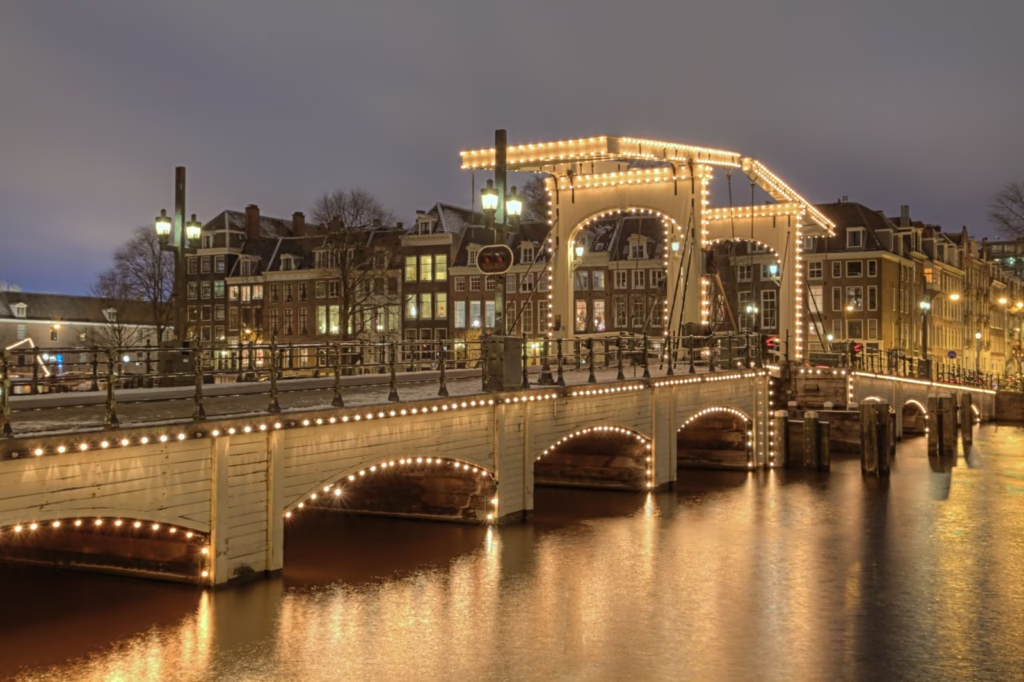
The Magere Brug, or “Skinny Bridge,” is without a doubt the most famous bridge in Amsterdam. Legend says it was named for two wealthy, frail sisters who lived on opposite sides of the Amstel and wanted a faster way to visit. In reality, the name likely comes from the original 1691 structure, which was so narrow that two people could barely pass. The version you see today, built in 1934, is a double-leaf wooden drawbridge (a wipbrug), elegantly painted white and spanning the wide, open Amstel river.
This bridge is a true time traveler. It is one of the few remaining large wooden drawbridges in the city center, offering a stark and beautiful contrast to the massive, concrete, 21st-century infrastructure that now dominates the outskirts. For me, it is at its absolute best at dusk. When the 1,200 small lights outline its white framework against the evening sky, and its image is reflected in the water, it perfectly captures the romantic, historical heart of Amsterdam.
2. Torensluis
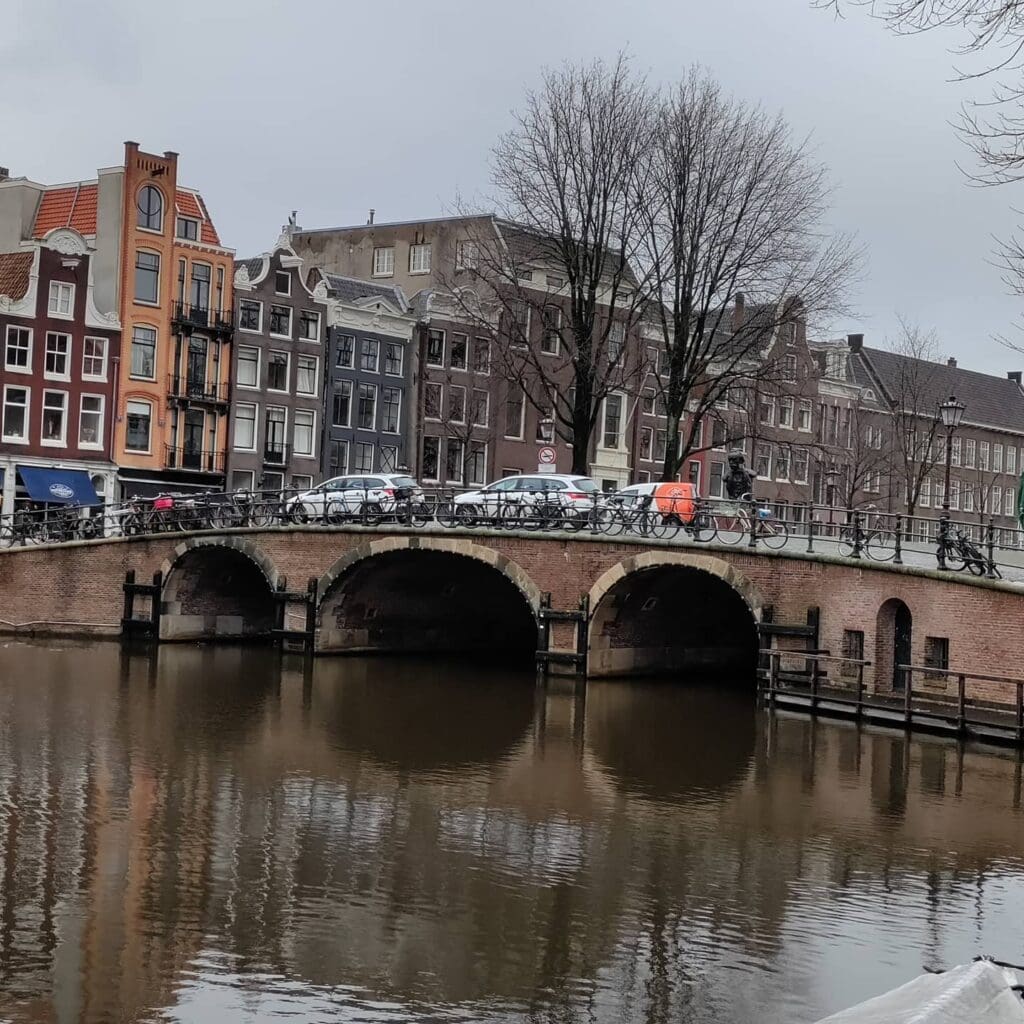
Welcome to Bridge No. 9, the Torensluis. If you are looking for the absolute soul of Amsterdam, this is it. Built in 1648, the Torensluis (Tower Lock) is the widest bridge in the city, but its width is a result of a 17th-century engineering decision, not traffic. It was originally built next to a massive defensive tower, the Jan Roodenpoortstoren, which was demolished in 1829. To compensate for the loss of the tower, the city simply widened the bridge into a vast, brick-arched terrace that effectively created a public square over the Singel canal.
This bridge is packed with layers of history. You can still see a bronze bust of the 19th-century writer Multatuli (Eduard Douwes Dekker) on the bridge, a fitting spot as the city’s heart. Perhaps its most fascinating feature is hidden below: the bridge’s massive foundations were used as dungeon cells for centuries, and you can still see the barred, low windows that once held prisoners just above the waterline. The Torensluis is a perfect example of a bridge that functions as a destination, not just a crossing.
3. Blauwbrug (Blue Bridge)
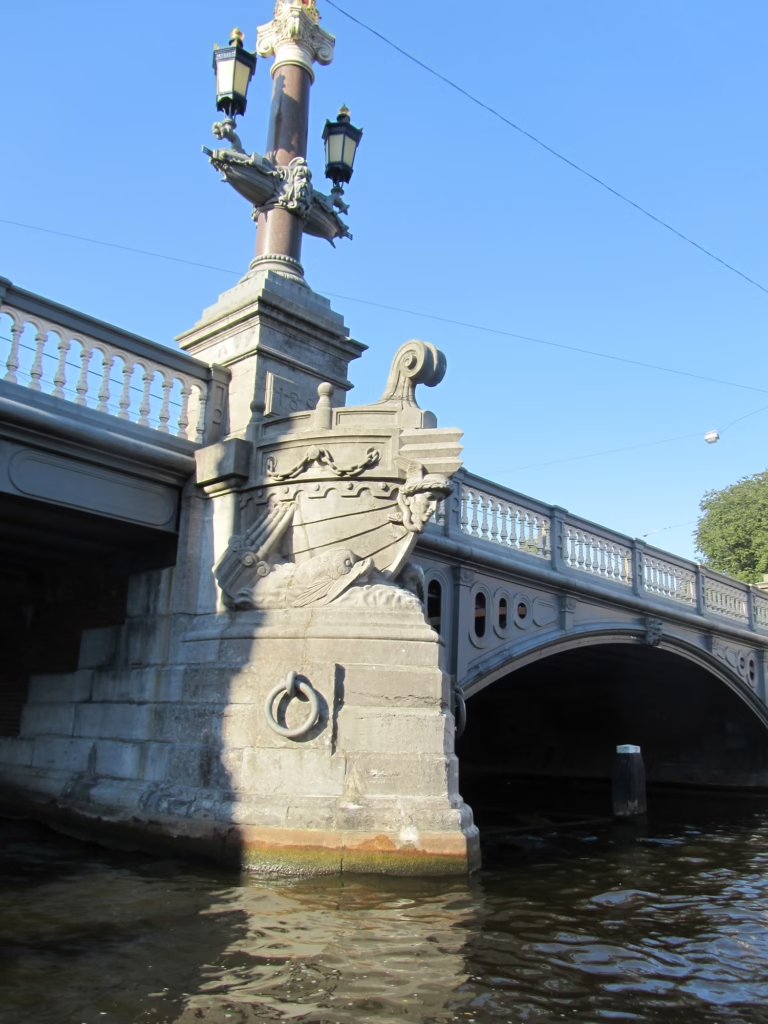
The Blauwbrug (Blue Bridge), officially Bridge No. 101, is a gorgeous, contradictory name. It is not blue at all, but a beautiful Parisian-style stone arch bridge. The name is a direct reference to a 17th-century wooden bridge that was indeed painted a bright, distinctive blue. That original structure was a simple crossing, but in 1883, to celebrate a series of grand events including the World Exhibition, the city replaced it with the ornate, three-arched stone bridge you see today.
This bridge is a stunning piece of Imperial-style architecture, clearly inspired by the crossings of the Seine. Its lamp posts are capped with ornate crowns—representing the Austrian Imperial Crown—and the stonework features sculptural elements depicting maritime history, complete with tridents and ship’s prows. It crosses a wide stretch of the Amstel, offering a powerful, symmetrical vantage point. The Blauwbrug is a reminder that Amsterdam was not just a merchant city, but a world capital that embraced the architectural language of empire.
4. Sint Anthoniesluis (St. Anthony’s Lock)
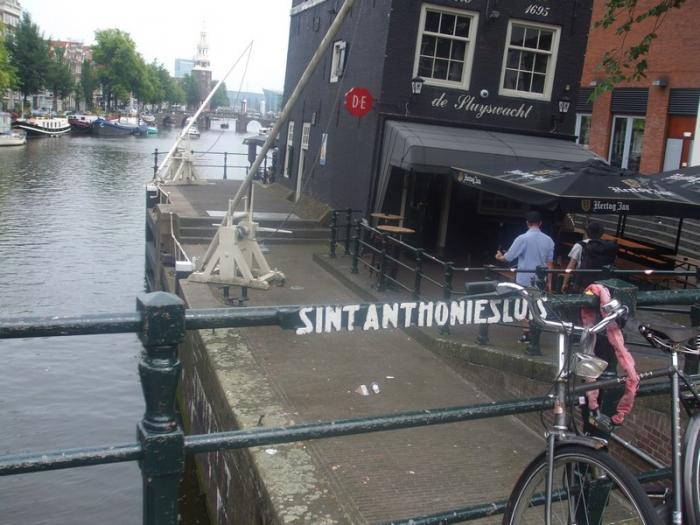
While many visitors admire the medieval towers of the De Waag (the Weigh House), the real engineering marvel of the Nieuwmarkt is found just a few steps away at Bridge 215, the Sint Anthoniesluis. This isn’t just a bridge; it is a vital lock system that has regulated the water levels between the city’s old canals and the Amstel river since the 17th century. It serves as a literal gateway to the historic center, and the surrounding square feels like a stage where centuries of Amsterdam’s trade and defense history are still visible in the brickwork.
Standing on this bridge offers one of the most evocative views in the city. To one side, you have the massive, fairy-tale towers of the Weigh House, and to the other, a row of notoriously “leaning” houses that look as though they are holding each other up. Because it functions as a lock, you can often watch the water levels being adjusted, a slow, mechanical reminder of the city’s constant battle with the sea. It is a perfect spot to capture the maritime soul of the old Lastage district, where ships were once built and goods from the corners of the globe were weighed and taxed.
5. Jan Schaeferbrug
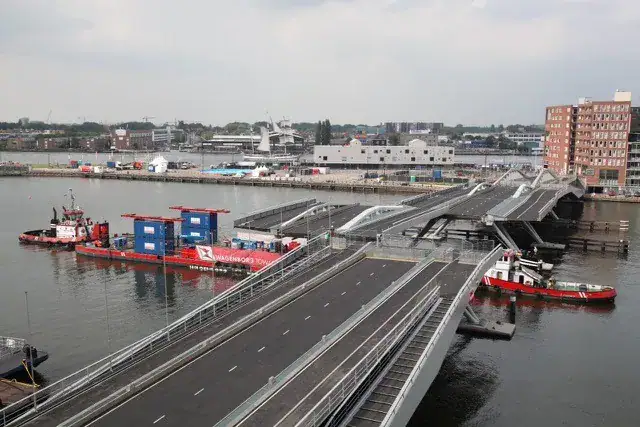
If you are a fan of modern engineering, the Jan Schaeferbrug (Bridge No. 1150) is a must-see. Named after the celebrated Dutch urban planner, this massive, 200-meter-long steel and concrete structure was completed in 2001. Its purpose was audacious: to connect the old city center (Piet Heinkade) directly to the new, rising residential neighborhood of IJburg on the distant KNSM Island and Java Island.
This is a bridge of radical contrast. To accommodate huge international ships and river cruise liners, the Jan Schaeferbrug is an extreme drawbridge (an hefbrug). The massive, central steel section can lift vertically to an incredible height, suspended between two gigantic pillars. When closed, it is a sleek, low-profile artery; when open, it is a piece of kinetic industrial art that looks like something out of a science fiction film. It’s a statement of 21st-century ambition, proving that a bridge can be both a functional gateway and a powerful monument.
6. Nesciobrug
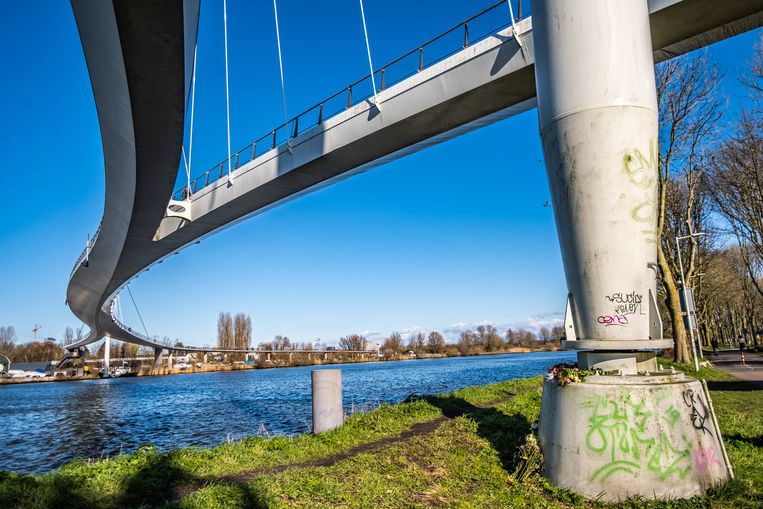
This is a bridge I have come to appreciate deeply, Bridge No. 1152, named for the Dutch writer Nescio (Frits Grönloh). Completed in 2006, the Nesciobrug is a gorgeous example of a cable-stayed bridge. It is a dedicated pedestrian and bicycle path, and its structure is a study in elegant suspension, with a single, slender concrete pylon supporting a curving, delicate network of steel cables that hold the deck over the wide Amsterdam-Rhine Canal.
This bridge solved a massive disconnect, linking the dense city neighborhood of Oost with the IJburg islands and the green spaces of Diemen. For me, its beauty lies in how the curve of the bridge deck mirrors the landscape of the nearby Diermerpolder and how the cables create an abstract pattern of lines and shadows against the sky. It is a light, dynamic structure that demonstrates how modern engineering can connect communities while still making a beautiful architectural statement.
7. High Bridge (Hoge Brug)
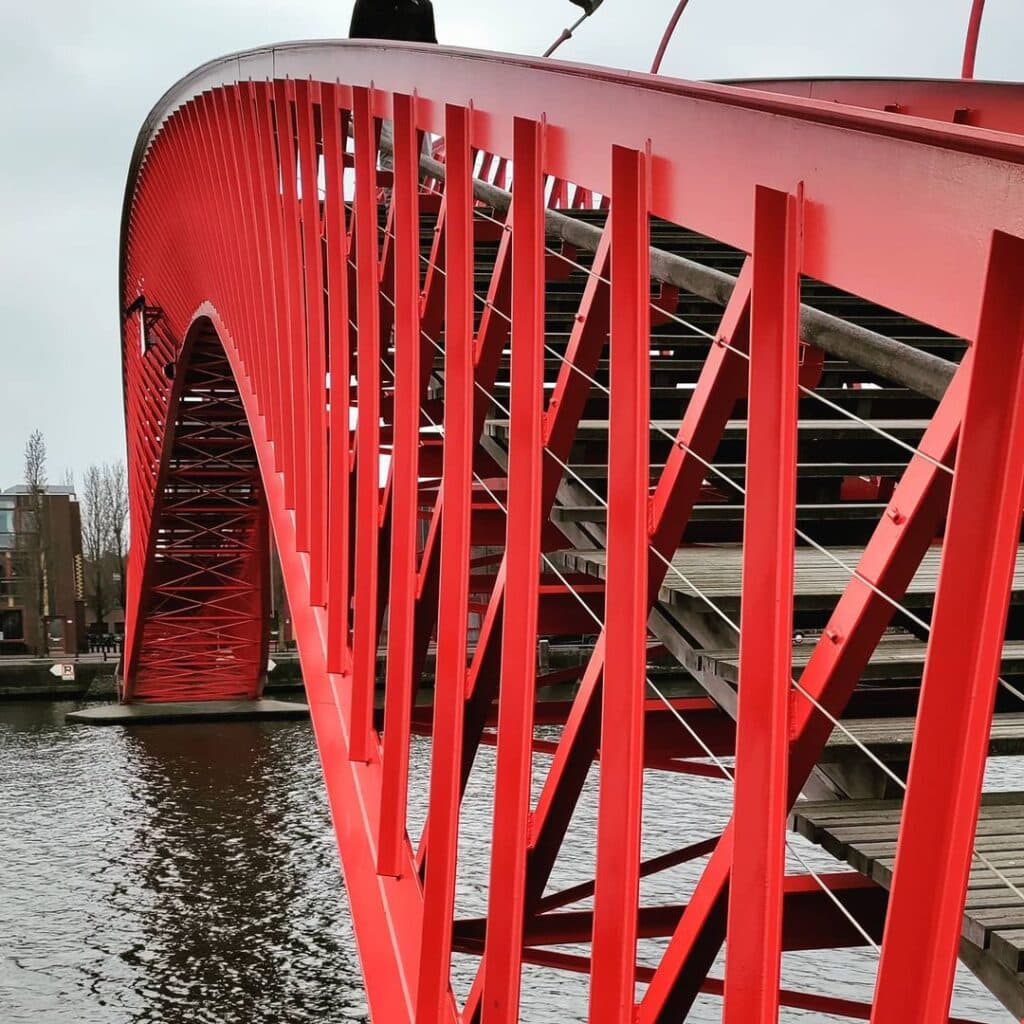
This bridge is a simple name for a spectacular view. Officially Bridge No. 111, the Hoge Brug (High Bridge) is located in Amsterdam-Noord, spanning the IJ river near the Eye Filmmuseum. It is an asymmetrical, fixed pedestrian and bicycle bridge, with a long, rising approach that lifts you up and over the wide waterway. It is an elevated highway for pedestrians, designed to offer an uninterrupted connection in a way that typical drawbridges cannot.
For me, the entire purpose of this bridge is the perspective. As you ascend, the city of Amsterdam opens up before you. You get a panoramic view of the IJ, the bustling southern waterfront, the ferry traffic, and the entire city center skyline dominated by the Oude Kerk tower. The Hoge Brug is more than just a crossing; it is an observation deck that helps you understand the scale of the city and its essential relationship to the open water.
8. Nieuwe Amstelbrug
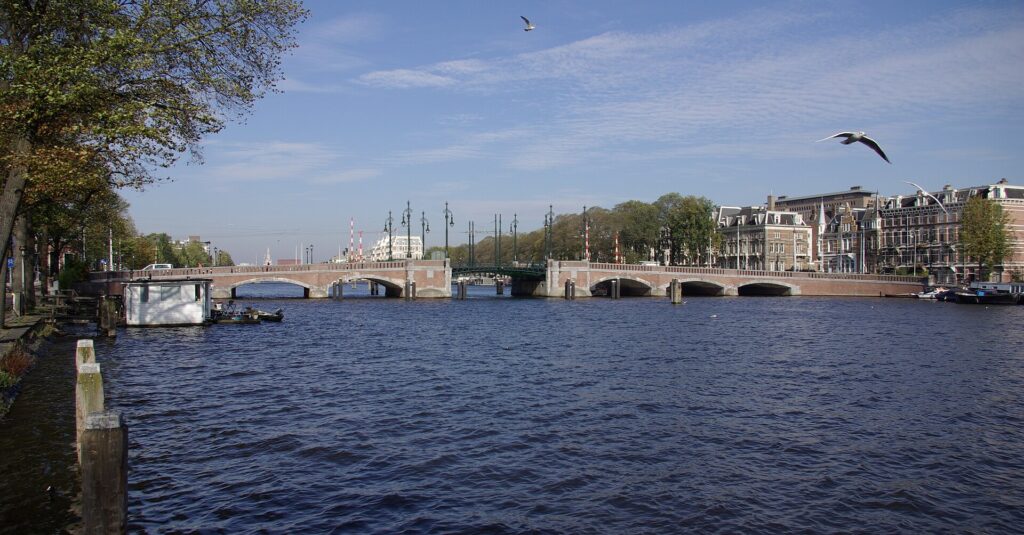
The Nieuwe Amstelbrug (New Amstel Bridge, Bridge No. 106) is a powerful historical marker. Completed in 1913, it was a crucial infrastructure project designed to link the growing city center (specifically the Ceintuurbaan) with the new Rivierenbuurt neighborhood being developed in the south. This is an excellent example of a traditional Amsterdamse School architecture style bascule drawbridge, constructed of heavy stone, concrete, and ornate, curved metalwork that feels very grounded in the turn of the century.
I love this bridge for its robust, confident design. It features a specific type of draw mechanism called a bascule, where the massive central leaf is counterweighted and pivots up on a single axis. The heavy stone pillars and intricate metal railings are a testament to early 20th-century craftsmanship. When it opens to allow large ships to pass on the Amstel, it operates with a powerful, industrial grace. It is a bridge that feels like a solid, essential part of the city’s anatomy.
9. Kikkerbilssluis
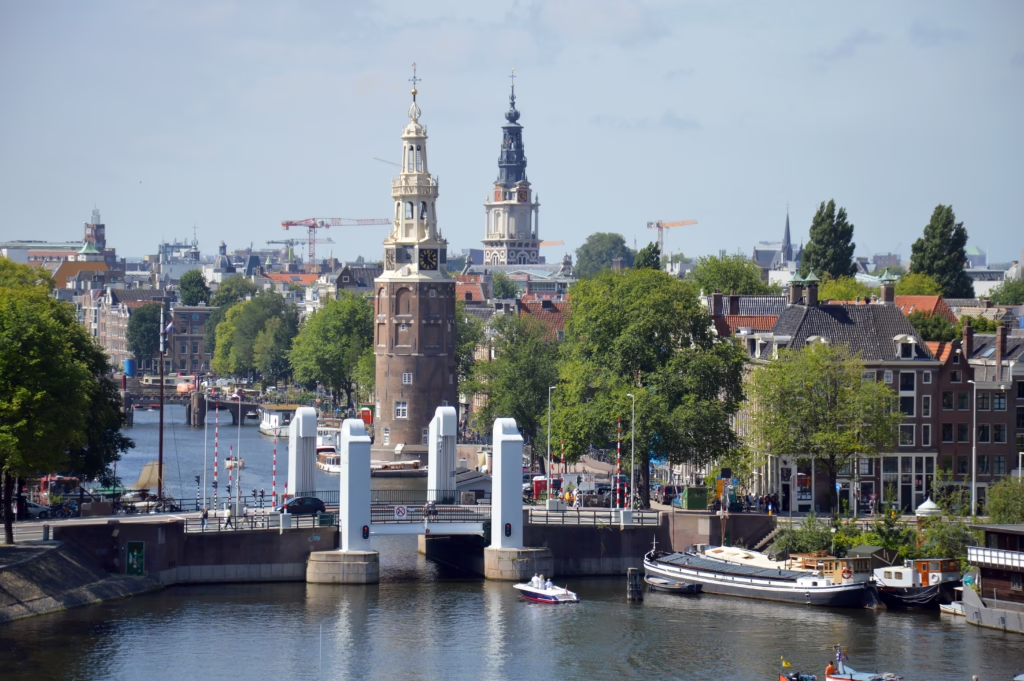
The Kikkerbilssluis (Bridge 279) is a standout example of how Hildo Krop and architect Piet Kramer could turn a functional maritime checkpoint into a piece of expressive street art. Located where the Prins Hendrikkade meets the Schippersgracht, this bridge serves as a gateway to the eastern islands and the old shipyards. Krop’s contributions here are famously playful; he adorned the granite bridgeheads with four massive, stylized sculptures of frogs (Kikker is Frog in Dutch). These granite amphibians sit perched on the stone blocks, their chunky and simplified forms perfectly capturing the “Amsterdam School” aesthetic of bold, rounded geometry.
The choice of frogs is a clever nod to the bridge’s name, which translates literally to “Frog Leg Sluice.” Historically, this area was known for its marshy terrain where frogs were abundant, and Krop used this local folklore to give the bridge a distinct personality. Beyond the frogs, the bridge features intricate wrought iron railings and heavy masonry that exemplify the partnership between art and infrastructure. For the bridgehunter, the Kikkerbilssluis is a must-visit because it demonstrates Krop’s ability to use humor and local history to anchor a massive stone structure into the fabric of its neighborhood.
10. Berlagebrug
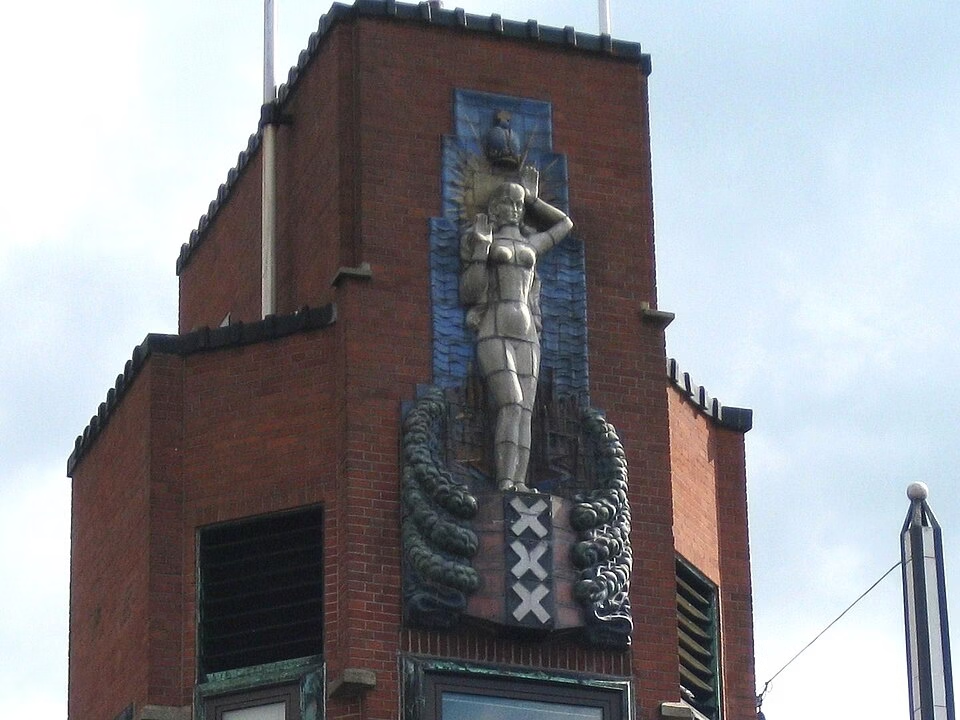
The Berlagebrug (Bridge 213) is arguably the most monumental collaboration between Hildo Krop and the city’s architects, serving as a grand ceremonial entrance to southern Amsterdam. Completed in 1932, this massive span across the Amstel river was designed by H.P. Berlage himself, but it is Krop’s sculptural tower that gives the bridge its soul. Rising high above the water on a brick and stone pillar sits the “Genius of Amsterdam,” a seated figure clad in shimmering golden-yellow ceramic tiles. This figure represents the spirit of the city, rising from the water and gazes toward the future, flanked by reliefs that depict the city’s maritime power and historical strength.
Krop’s work on the Berlagebrug is a masterclass in scale and symbolic storytelling. While the “Genius” sits atop the pillar, the base of the bridge features heavy granite reliefs that ground the structure in the physical reality of the Amstel. These carvings depict “The Amstel” as a powerful figure, alongside themes of trade and industry that built the city’s wealth. The use of vibrant ceramics alongside the somber, dark granite creates a visual tension that is unique to the later period of the Amsterdam School. For the bridgehunter, the Berlagebrug is the ultimate “destination bridge” because it functions as a total work of art, where every brick, tile, and stone carving works together to tell the story of a city at the height of its modern ambition.
This is my list of the top ten bridges in Amsterdam. I hope this has shown you that a bridge is never just a crossing, it is a connection, a historical marker, and an architectural statement.
I’m on a mission to photograph and catalog all 1,200+ spans, and you can follow along on my project pages. Which of these bridges is your favourite, and which Amsterdam bridge do you think I should cross next?