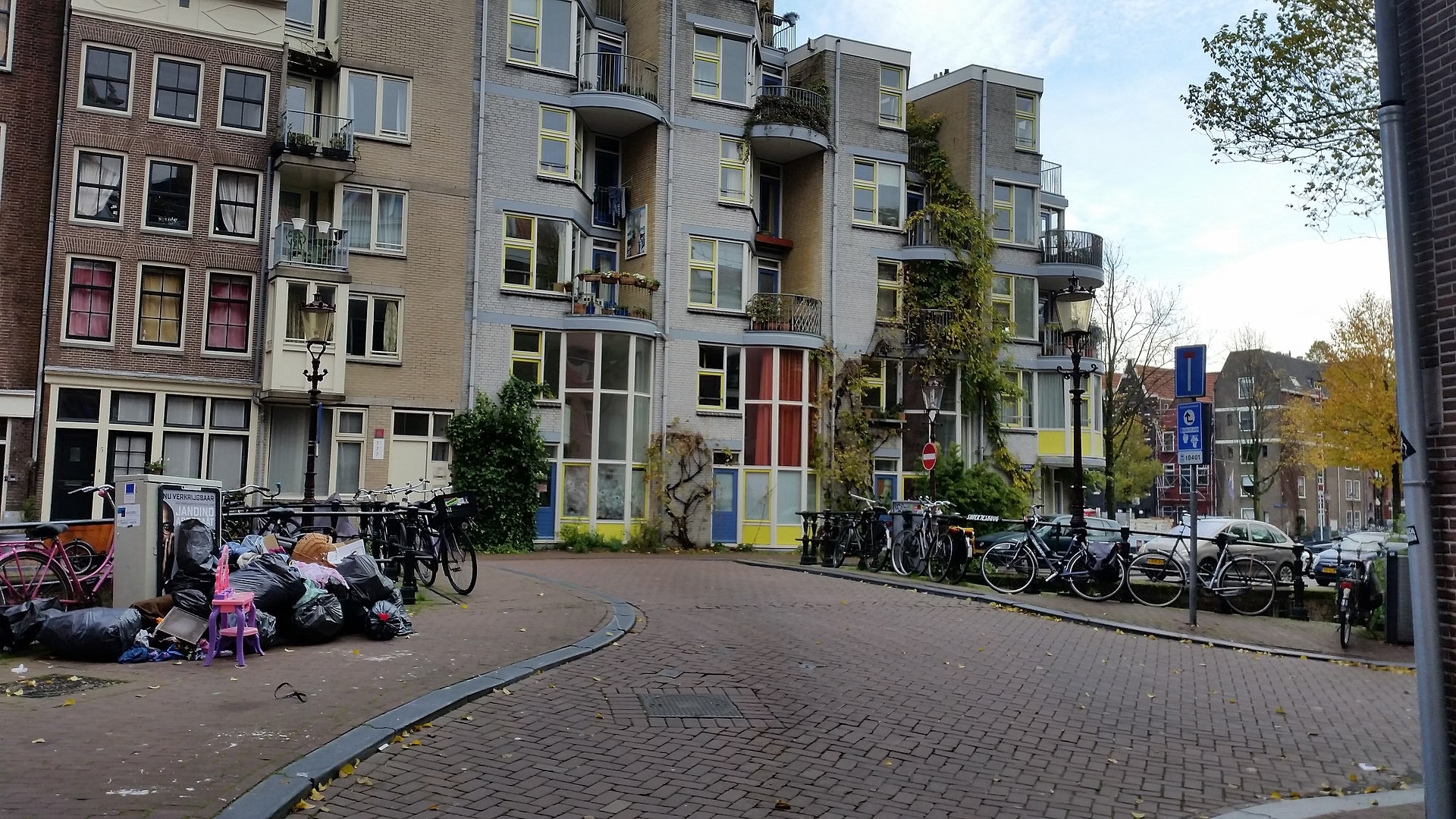
The Bridge Named After a Man, Not a Fish: Brug 289
Snoek is the Dutch for pike. Snoekjes is the diminutive, little pikes. A bridge called the Snoekjesbrug, standing over a canal called the Snoekjesgracht in a city built on water, invites an obvious conclusion, and the obvious conclusion is wrong.
Brug 289 is a fixed bridge in Amsterdam-Centrum, lying in line with the Snoekjessteeg and crossing the Snoekjesgracht. Its name comes from a man who built a house here in 1595 and was called Jan Pieters Snoeck.
Etymology: Jan Pieters Snoeck and the Habit of Naming Things After Whoever Lived There
Amsterdam names its streets in two ways. Some are named for what happened on them, and those are the ones everybody quotes: Haringpakkerssteeg for the herring packers, Papenbrugsteeg for the priests, Kalverstraat for the calves.
The rest are named for whoever owned the conspicuous house on the corner. Jan Pieters Snoeck built his in 1595, on ground that had only recently been brought inside the city, and the alley took his name. The alley gave its name to the canal, and the canal gave its name to the bridge. Three centuries later the fish had entirely taken over the story, helped along by the fact that the surname Snoeck is the fish, and that it was a common enough name for exactly that reason.
This kind of drift is not rare here. We have followed the same pattern at Bridge 49 and elsewhere in the series, where a name that sounds descriptive turns out to be a person, or the other way round. It is one of the more reliable pleasures of reading Amsterdam’s bridges: the plausible answer is very often the wrong one.
Structural Evolution: 1599, 1847, 1888
A crossing has stood on this line for centuries. Pieter Bast’s map of 1599, drawn four years after Snoeck built his house, shows a drawbridge at this point, which means the earliest bridge here opened.
That movable structure eventually gave way to a fixed timber bridge, and in 1847 the wooden bridge was replaced. Four decades later the city went further. In 1888 the municipality issued a tender to renew and widen fixed bridge number 289, and that instruction produced the bridge standing today.
The wording of the tender is worth noticing. Not replace, but renew and widen. The 1880s were the decade in which Amsterdam systematically broadened its inner-city crossings to take heavier cart traffic and, shortly afterwards, trams. Dozens of bridges were rebuilt low, wide and flat in this period, and a great many of the arched crossings that appear in seventeenth-century paintings vanished in the process. Brug 289 was widened; the movable bridges elsewhere in the city were, in many cases, simply fixed shut.
The design is generally attributed to Bastiaan de Greef, the city architect responsible for an enormous share of nineteenth-century Amsterdam bridgework, though the attribution is not firmly documented for this particular span. After 1959 the bridge went through a substantial renovation that deliberately preserved its nineteenth-century appearance rather than modernising it, which is why a bridge with modern load capacity still reads as Victorian from the water.
Urban Context: The Snoekjesgracht and the Nieuwmarkt Edge
The Snoekjesgracht is short, and it sits at one of the more historically violent junctions in the city, though nothing about it looks that way now.
A few dozen metres west is the Nieuwmarkt, and immediately south the Sint Anthoniesluis, Brug 287, on the line of the Sint Antoniesbreestraat. That whole strip was condemned in the 1960s to make room for a metro line and an urban motorway, and much of it was demolished before the Nieuwmarkt riots of 1975 stopped the motorway permanently. The metro was built; the road was not.
The Snoekjesbrug came through it. Its neighbours on the far side of the Sint Antoniesbreestraat did not, and the Steenvoetsluis at Brug 291 lost its canal entirely for a decade before the water was dug out again. Against that, a bridge that has needed nothing more dramatic than a widening in 1888 and a careful renovation after 1959 counts as a quiet life.
There are municipal and national monuments on the southwest side of the bridge, which is to say the buildings are protected even though the bridge itself is not. That asymmetry is common in this part of the city and usually means the same thing: the surroundings are older than the crossing.
Technical Specifications
- Bridge number: 289
- Name: Snoekjesbrug
- Type: Fixed bridge (vaste brug)
- Carries: The line of the Snoekjessteeg
- Spans: Snoekjesgracht
- District: Amsterdam-Centrum
- Coordinates: 52.3706 N, 4.9014 E
- Named after: Jan Pieters Snoeck, who built a house here in 1595
- Recorded on Pieter Bast’s map: 1599, as a drawbridge
- Wooden bridge replaced: 1847
- Current structure: 1888, following a tender to renew and widen
- Attributed architect: Bastiaan de Greef, not firmly documented
- Major renovation: after 1959, preserving the nineteenth-century appearance
- Status: Bridge unprotected; monuments stand on the southwest side
Sources Consulted
- Featured image: Snoekjesbrug, Bridge 289, Amsterdam by Ceescamel, 2019, via Wikimedia Commons, CC BY-SA 4.0
- Snoekjesbrug, Nederlandstalige Wikipedia
- Snoekjesgracht, Nederlandstalige Wikipedia
- Bastiaan de Greef, Nederlandstalige Wikipedia
- Pieter Bast, Nederlandstalige Wikipedia
- Wikimedia Commons, Category: Brug 289, Snoekjesbrug
- Stadsarchief Amsterdam, Beeldbank and Publieke Werken archives
- Bruggen van Amsterdam
- Frank V. Smit, Bruggen in Amsterdam (2008), Uitgeverij Matrijs