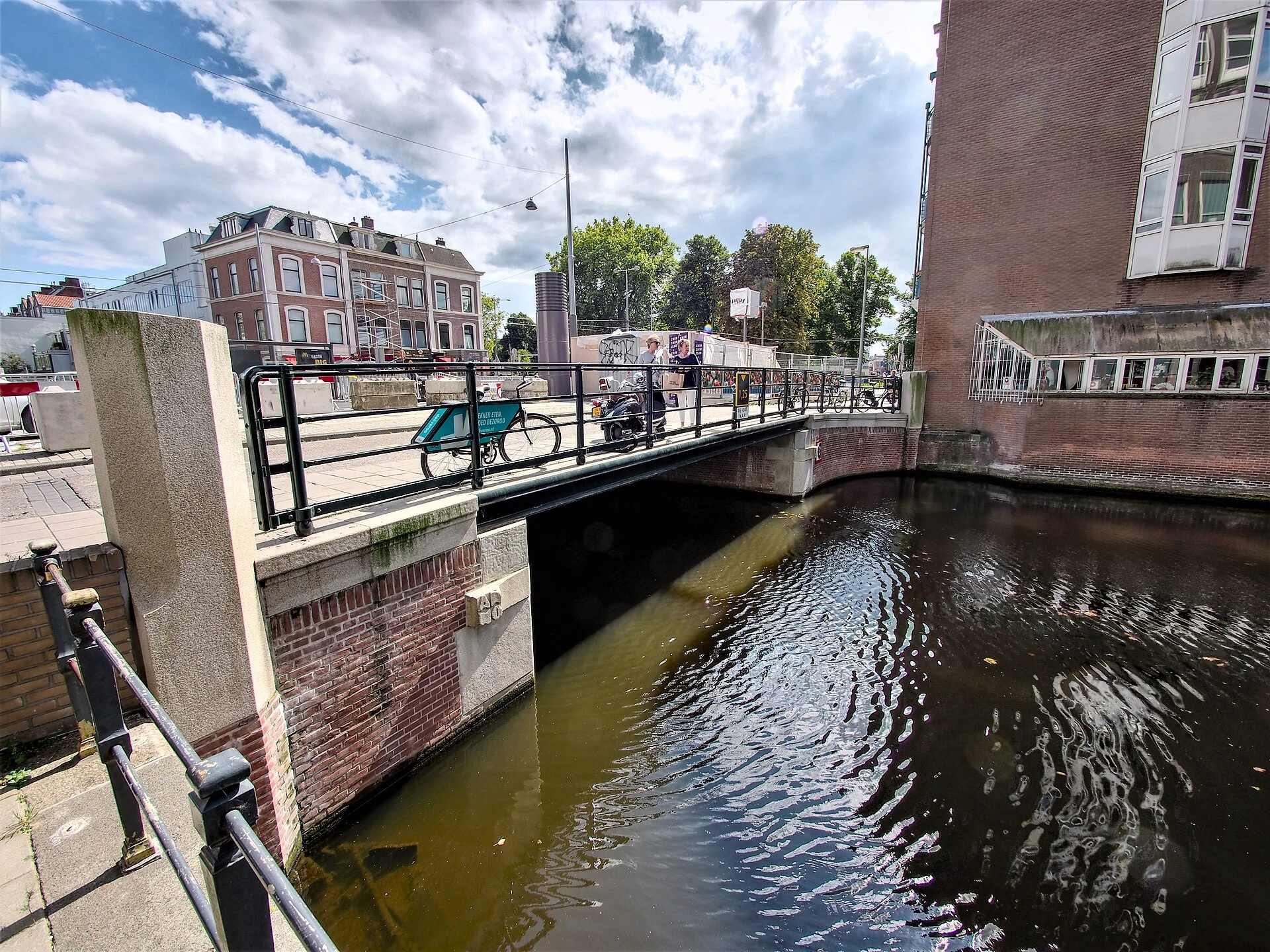
Piet Kramer on a Traffic Road: Brug 86 and the Bakery on the Lijnbaansgracht
Brug 86 carries the Nieuwe Vijzelstraat over the Lijnbaansgracht, and it is a Piet Kramer bridge doing a job Kramer bridges are not usually asked to do: carrying a main road built to move motor traffic through the centre of Amsterdam.
It was built in 1933 and 1934, and it is one of the crossings that survived the death of the Vijzelgracht rather than being taken away with it.
Etymology: The Bakkerijbrug
The bridge was known as the Bakkerijbrug, the bakery bridge, and the reason stood on the bank: from 1857 a flour and bread factory operated on the Lijnbaansgracht beside it.
This is the standard Amsterdam pattern. A bridge acquires the name of whatever was most conspicuous next to it, the trade outlasts nobody’s memory, and the name goes on being used long after the building has gone. The Berensluis has bear hides, the Haringpakkersbrug has herring packers, and Brug 86 had a bakery.
In 2016 Amsterdam formally discontinued its unofficial bridge names. A great many crossings that had been called something for a century became numbers again overnight, and Brug 86 was one of them. The same decision is why Brug 78 lost its name, and why Brug 69 is no longer the Antiquairbrug.
Structural Evolution: 1872, 1903, 1934
A bridge stood here from around 1872. It was rebuilt in 1903 to take tram traffic, which was the usual reason for rebuilding a bridge in that decade.
The decisive change came in 1929, when the city adopted plans for a major radial road running south out of the centre. The scheme involved partly filling the Vijzelgracht, which happened in 1933, and widening the route that ran along it. Work on the bridge began in 1932 and finished in the summer of 1934.
It was built in phases so that traffic could keep crossing throughout, which is a small detail that tells you how much the route already mattered before the road was finished.
Architectural Lineage: What Kramer Left on a Utility Bridge
Kramer designed well over two hundred bridges for the Dienst der Publieke Werken, and his best known are the expressive Amsterdam School crossings of the canal ring, with sculpted stonework by Hildo Krop and wrought iron that curls. Bridge 43 is the showpiece.
Brug 86 is not that. It is a wide fixed bridge on an arterial road, and the commission gave him almost no room for expression.
What he did with it is characteristic. The balustrade ends are marked with natural stone columns, and that is essentially the whole gesture: a piece of good stone at each of the four corners, establishing where the bridge begins and ends, on a structure whose brief was traffic capacity. It is the minimum an architect can do to insist that a bridge is a place rather than a length of road, and Kramer did it consistently across his career.
Worth knowing when you cross it, because at road level it reads as nothing at all.
Urban Context: A Canal That Survived Its Neighbour
The Vijzelgracht was filled in 1933 and its bridges went with it. Brug 86 survived for one reason: it does not cross the Vijzelgracht. It crosses the Lijnbaansgracht, which was not filled, and so the bridge kept its water and its purpose.
The same accident saved Brug 70, the Walenweeshuissluis, over the Prinsengracht. Everything in between, including Brug 83 and the original Brug 85, was demolished.
Underneath the street today runs the Noord/Zuidlijn, whose construction between 2002 and 2018 caused serious settlement to the historic buildings along this stretch.
The Radial Road That Reshaped This Corner
The 1929 plan behind this bridge belongs to a way of thinking that dominated Amsterdam for forty years: that the medieval and seventeenth-century centre needed to be made passable by car, and that the canals were the obstacle.
The Nieuwe Vijzelstraat was to be part of a radial route running from the centre out to the south, and the Vijzelgracht was filled to widen it. What was built is what you see: a broad, straight, heavily trafficked street cutting through the canal ring at right angles to everything around it, of a width no seventeenth-century street possesses.
The plan was never finished. The Nieuwmarktrellen of 1975 stopped the next generation of it, and the city abandoned the motorway schemes altogether in favour of small-scale development. Brug 86 is a fragment of the version that did get built, and Kramer’s four stone columns are the only part of it built for looking at.
Technical Specifications
- Bridge number: 86
- Former name: Bakkerijbrug, discontinued 2016
- Type: Fixed bridge, road and public transport
- Carries: Nieuwe Vijzelstraat
- Spans: Lijnbaansgracht
- District: Amsterdam-Centrum
- Coordinates: 52.3600 N, 4.8909 E
- Architect: Piet Kramer, Dienst der Publieke Werken
- Earlier structures: circa 1872, rebuilt 1903 for trams
- Current structure: begun 1932, completed summer 1934
- Detail: Natural stone columns marking the balustrade ends
- Status: Not a designated monument
Sources Consulted
- Featured image: Brug 86, Bridge 86, Amsterdam by Alf van Beem, 2017, via Wikimedia Commons, CC0
- Brug 86, Nederlandstalige Wikipedia
- Piet Kramer, Nederlandstalige Wikipedia
- Vijzelgracht, Nederlandstalige Wikipedia
- Lijnbaansgracht, Nederlandstalige Wikipedia
- Bruggen van Amsterdam
- Stadsarchief Amsterdam, Beeldbank and Publieke Werken archives
- Sebas Baggelaar and Pim van Schaik, Piet Kramer, Bruggenbouwer van de Amsterdamse School (2016)