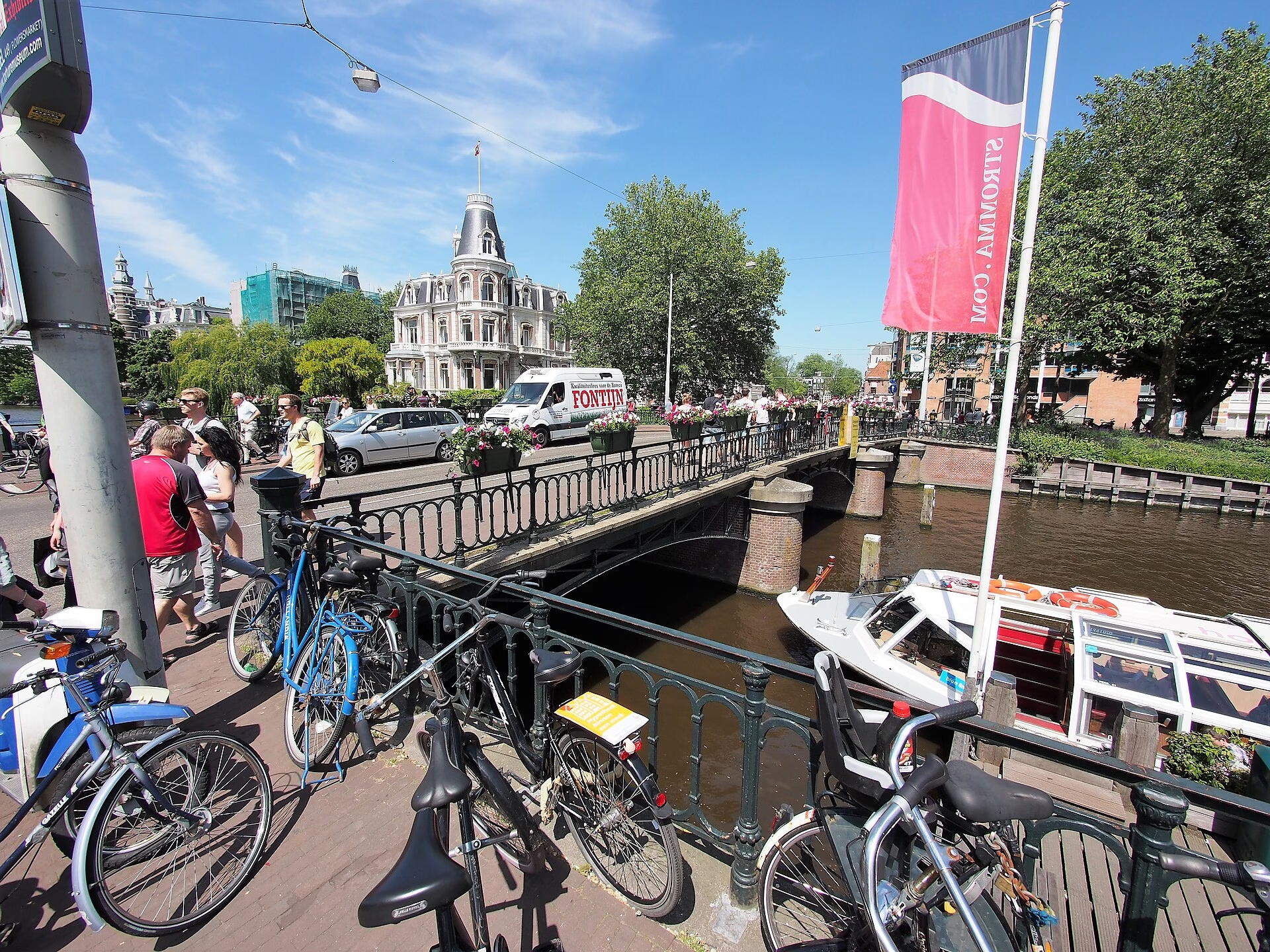
The Bridge Built for a Museum: Brug 82, the Museumbrug
Most Amsterdam bridges are named after what was already there. The Museumbrug is named after something that had only just arrived, and it exists because of it.
Brug 82 carries the Weteringschans across the Singelgracht to the Stadhouderskade, landing directly in front of the Rijksmuseum. It was built in 1877, while the museum itself was still under construction, and its entire purpose was to connect the new national museum to the old city.
Etymology: A Name That Points Forward
The Rijksmuseum was designed by Pierre Cuypers and opened in 1885, eight years after the bridge. When Brug 82 went in, the museum was a building site.
That ordering is the whole story of this crossing. Amsterdam had decided to put its national collection outside the Singelgracht, on what was then the edge of the city, and a museum on the wrong side of a canal is a museum nobody visits. The bridge came first because it had to.
It is worth contrasting with the bridges of the old centre, whose names record herring packers, tanners, bear hides and cheese markets, trades that were already dying when the names were fixed. The Museumbrug is one of the few Amsterdam bridges named after the future.
Structure: Hardstone, Iron and the Public Works House Style
It is a plaatbrug, a plate bridge, built by the Dienst der Publieke Werken. Semicircular hardstone piers carry arched iron trusses, and the parapet is iron balusters and balustrades of the type the department fitted across the city in this period.
Whether the city architect Bastiaan de Greef and his assistant Willem Springer had a hand in it is not settled. Both were working on Amsterdam’s bridges in exactly these years, and the detailing is consistent with their output, but the drawings carry no attribution. The same uncertainty attaches to several bridges of the 1870s and 1880s.
The pairing is worth noting: de Greef and Springer are the names behind the Blauwbrug of 1883, the grandest bridge Amsterdam built in the nineteenth century. Brug 82 is the same department in working clothes.
A Century of Traffic
The bridge has carried most things Amsterdam has needed to move across it.
- 1913: tram line 15 begins running over it, and the bridge is renovated to take the rails.
- 1922: tram line 6 added.
- 1942: tram service over the bridge ends.
- 1967 to 1981: bus routes use it.
- 1990: further renovation.
- 2023: reconfigured for one-way motor traffic with more room for cycling.
That last change is the result of the argument Amsterdam has been having with itself for thirty years, applied to a single crossing. A bridge widened in 1913 to carry trams and used through the twentieth century for cars has been narrowed again, for bicycles.
Urban Context: The Museumkwartier
The bridge sits on the boundary between Amsterdam-Centrum and Amsterdam-Zuid, and it marks a real change in the city rather than an administrative one. North of it is the seventeenth-century canal ring. South of it is the Museumkwartier, laid out in the late nineteenth century on a different logic entirely: broad streets, large plots, cultural institutions and villas.
Brug 82 is a gemeentelijk monument, a municipal monument, and it is surrounded by others, including two rijksmonumenten: the villa at Weteringschans 24 and the Rijksmuseum itself.
Cuypers, and the Museum the Bridge Was Waiting For
The Rijksmuseum was designed by Pierre Cuypers and opened in 1885. It was not universally welcomed. Cuypers was a Catholic architect working in a Gothic and Renaissance revival idiom in a Protestant merchant city, and the building was attacked at the time as looking like a cathedral, or a bishop’s palace, rather than a national institution. King Willem III is said to have refused to set foot in it.
None of that argument is visible from the bridge now, which is usually how these things end. What is visible is the axis: the Weteringschans runs at the museum, the bridge carries it over the water, and the building closes the view. That alignment was the point of building the crossing here.
The Singelgracht as a Boundary
The Singelgracht is not the Singel. The Singel is the medieval moat deep inside the modern centre. The Singelgracht is the outer defensive canal of the seventeenth-century city, the line beyond which Amsterdam did not build for two hundred years, and it is the boundary that gives the UNESCO-inscribed canal ring its official name: the Seventeenth-Century Canal Ring Area of Amsterdam inside the Singelgracht.
So Brug 82 crosses the edge of the old city in the most literal sense available. Everything on the far side, the Museumkwartier, the Vondelpark, the Rijksmuseum itself, belongs to a nineteenth-century Amsterdam that had finally outgrown its own defences and started building on the other side of them.
Technical Specifications
- Bridge number: 82
- Name: Museumbrug
- Type: Plaatbrug (plate bridge)
- Carries: Weteringschans to Stadhouderskade
- Spans: Singelgracht
- District: Boundary of Amsterdam-Centrum and Amsterdam-Zuid
- Coordinates: 52.3608 N, 4.8864 E
- Built: 1877
- Designer: Dienst der Publieke Werken, attribution to de Greef and Springer unconfirmed
- Materials: Hardstone piers, arched iron trusses, iron balusters
- Renovated: 1913, 1990, reconfigured 2023
- Status: Gemeentelijk monument
Sources Consulted
- Featured image: Museumbrug, Bridge 82, Amsterdam by Alf van Beem, 2017, via Wikimedia Commons, Public domain
- Museumbrug, Nederlandstalige Wikipedia
- Rijksmuseum Amsterdam, Nederlandstalige Wikipedia
- Wikimedia Commons, Category: Brug 82, Museumbrug
- Amsterdam op de kaart, Weteringschans
- Bruggen van Amsterdam
- Stadsarchief Amsterdam, Beeldbank
- Frank V. Smit, Bruggen in Amsterdam (2008), Uitgeverij Matrijs