The Python Bridge or Hoge Brug (bridge number 1998) is a pedestrian bridge in Amsterdam. There is also a lower Bridge (Lage brug) on the Island (bridge 1997). Since @bruggenvanamsterdam is only at 33 today it’s going to be a while before this one features
Hoge Brug Bridge Number 1998! Link to more photos on google photos.

It is stretched over the Railway Basin in the Eastern Docklands and connects the Panamakade on the Sporenburg peninsula with the Stuurmankade on the Borneo Island . The bridge was completed in 2001 in spite of the name plates saying anno 2000!
The official name used by the municipality and local residents is the Hoge Brug with the other twin red bridge to the west of this the Lage Brug (bridge 1997).

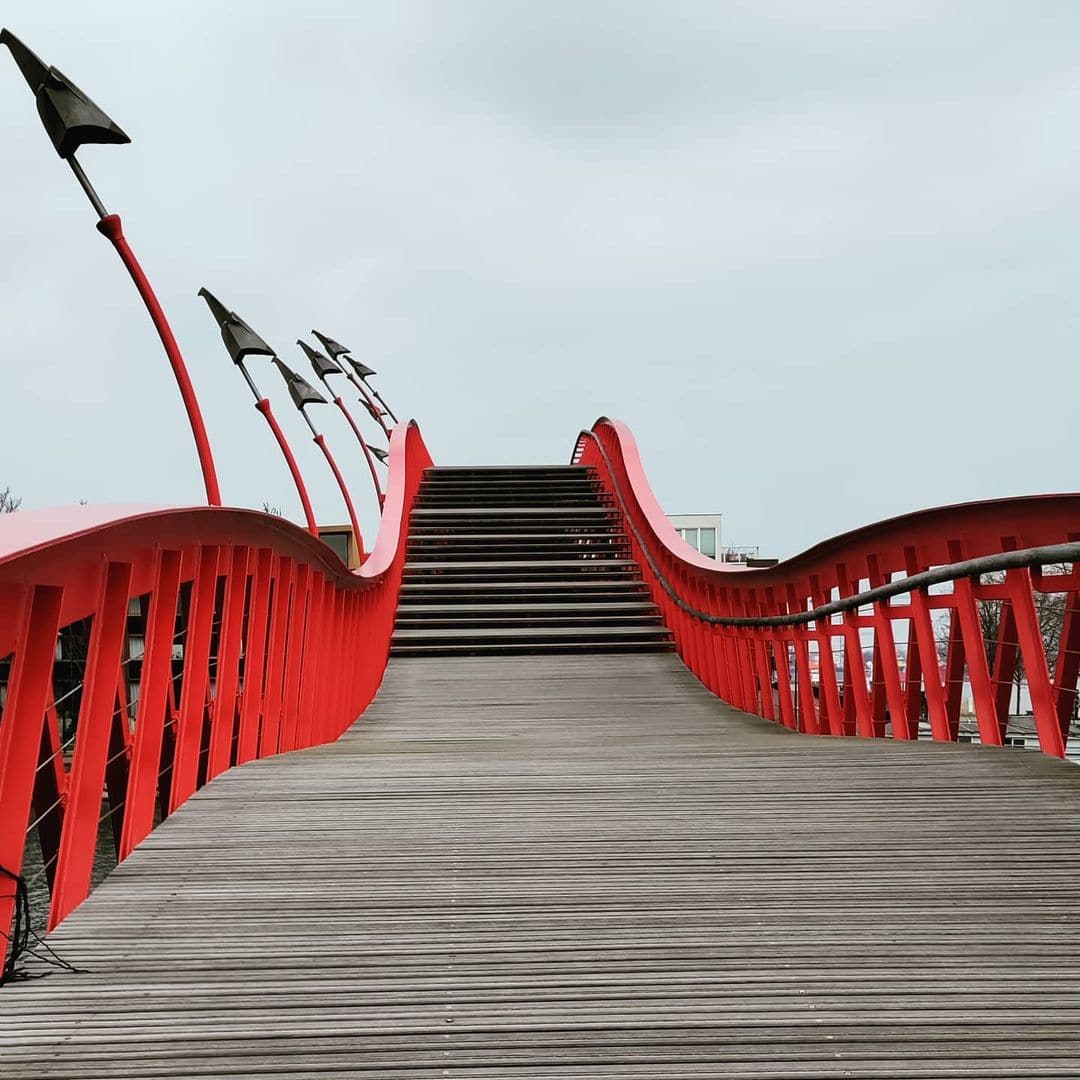
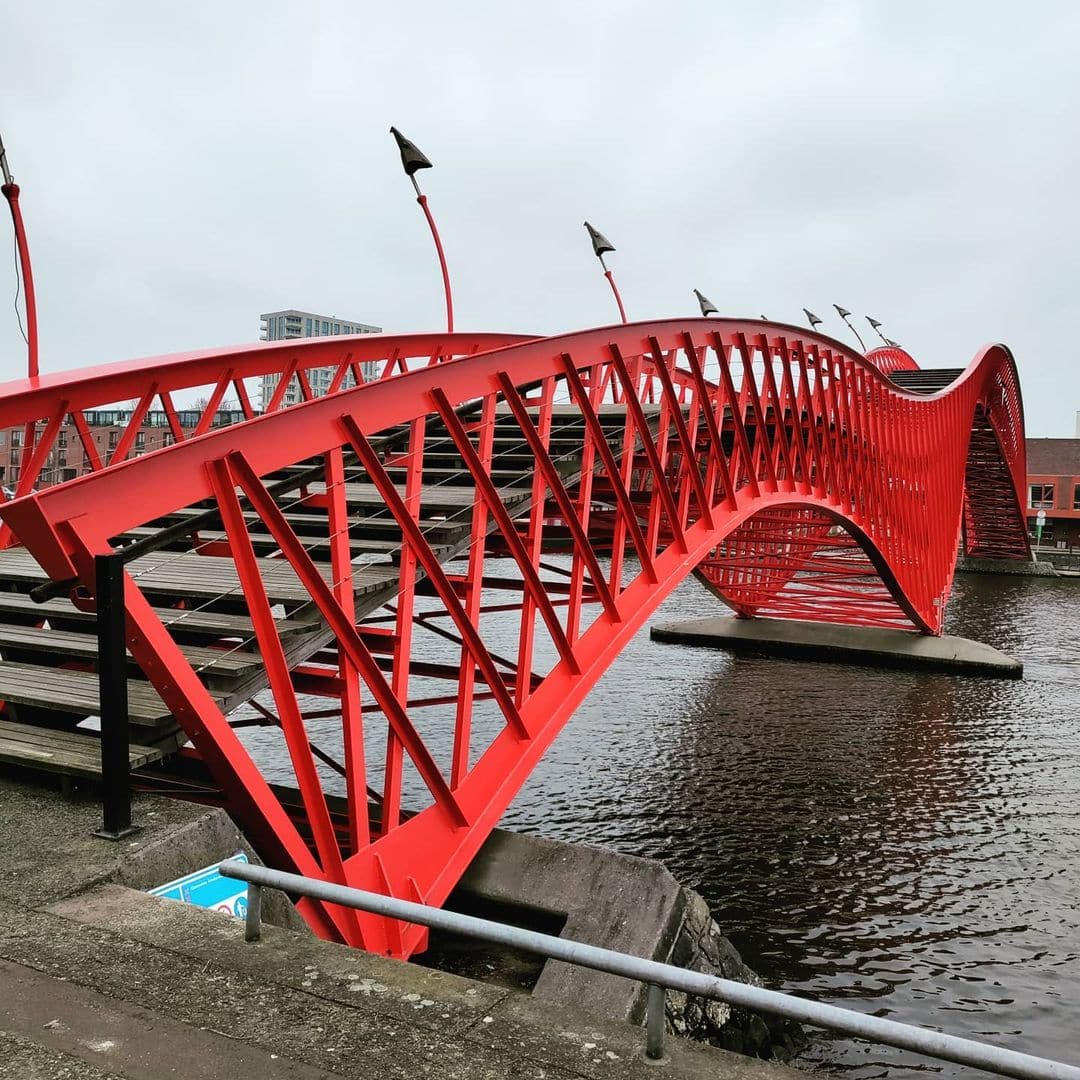

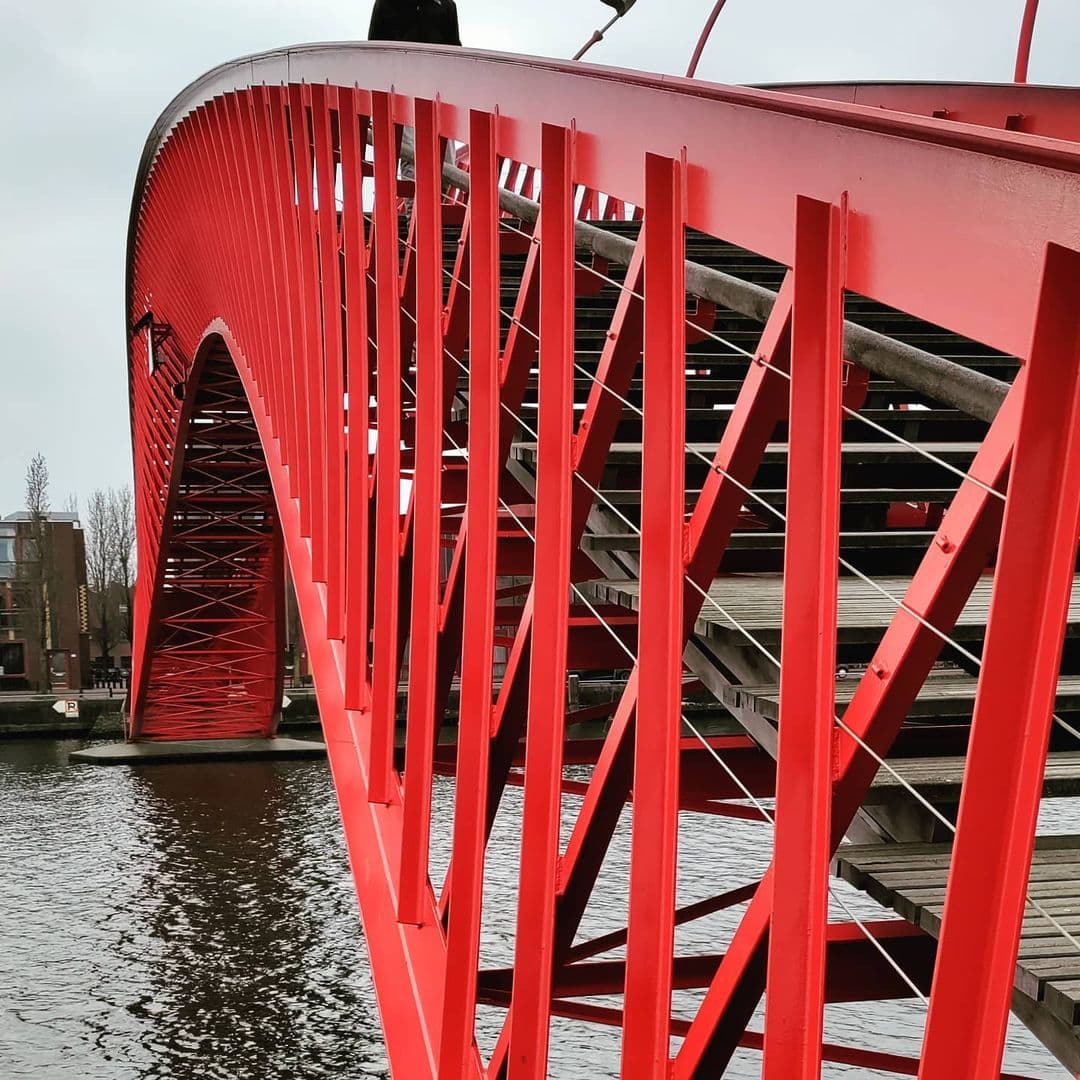

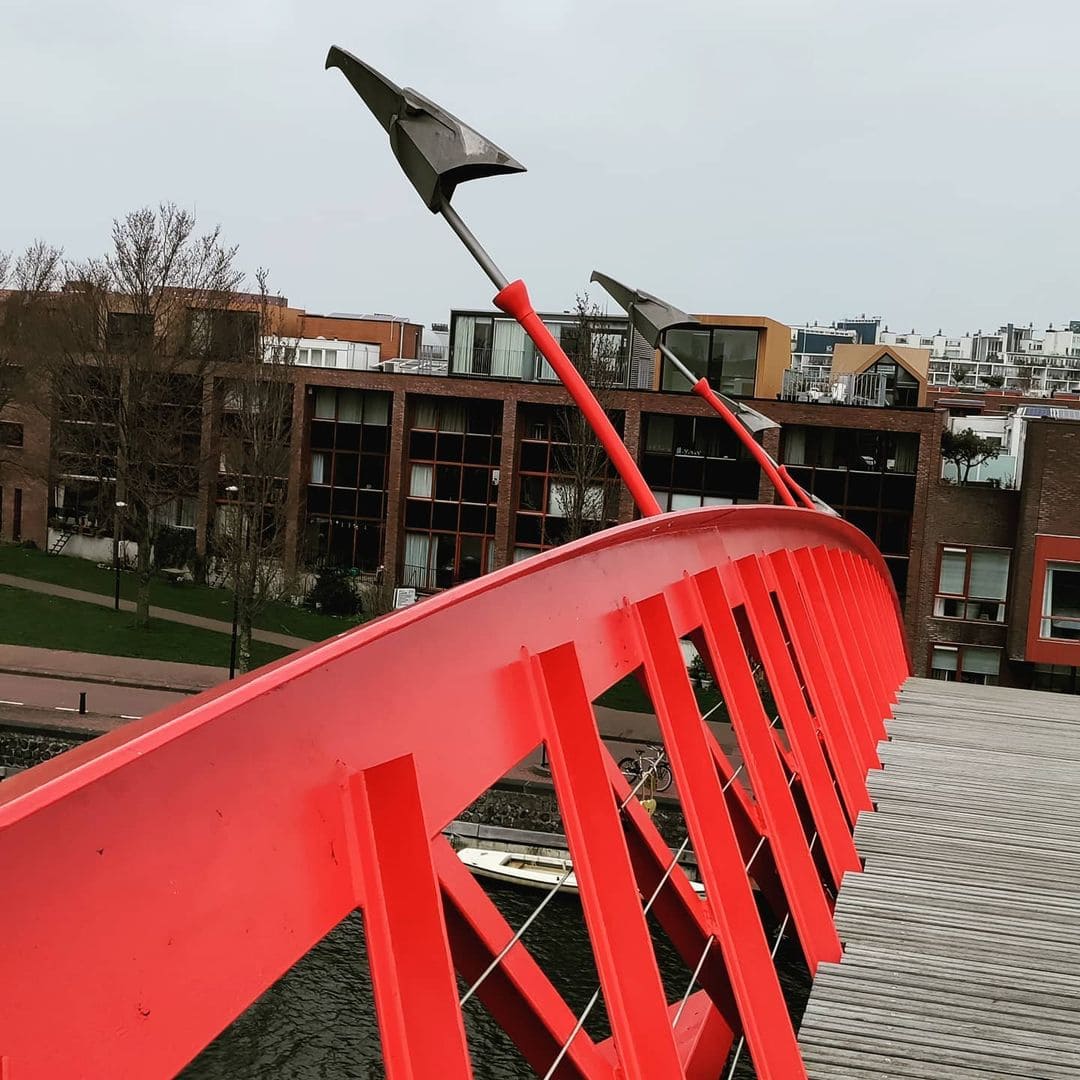


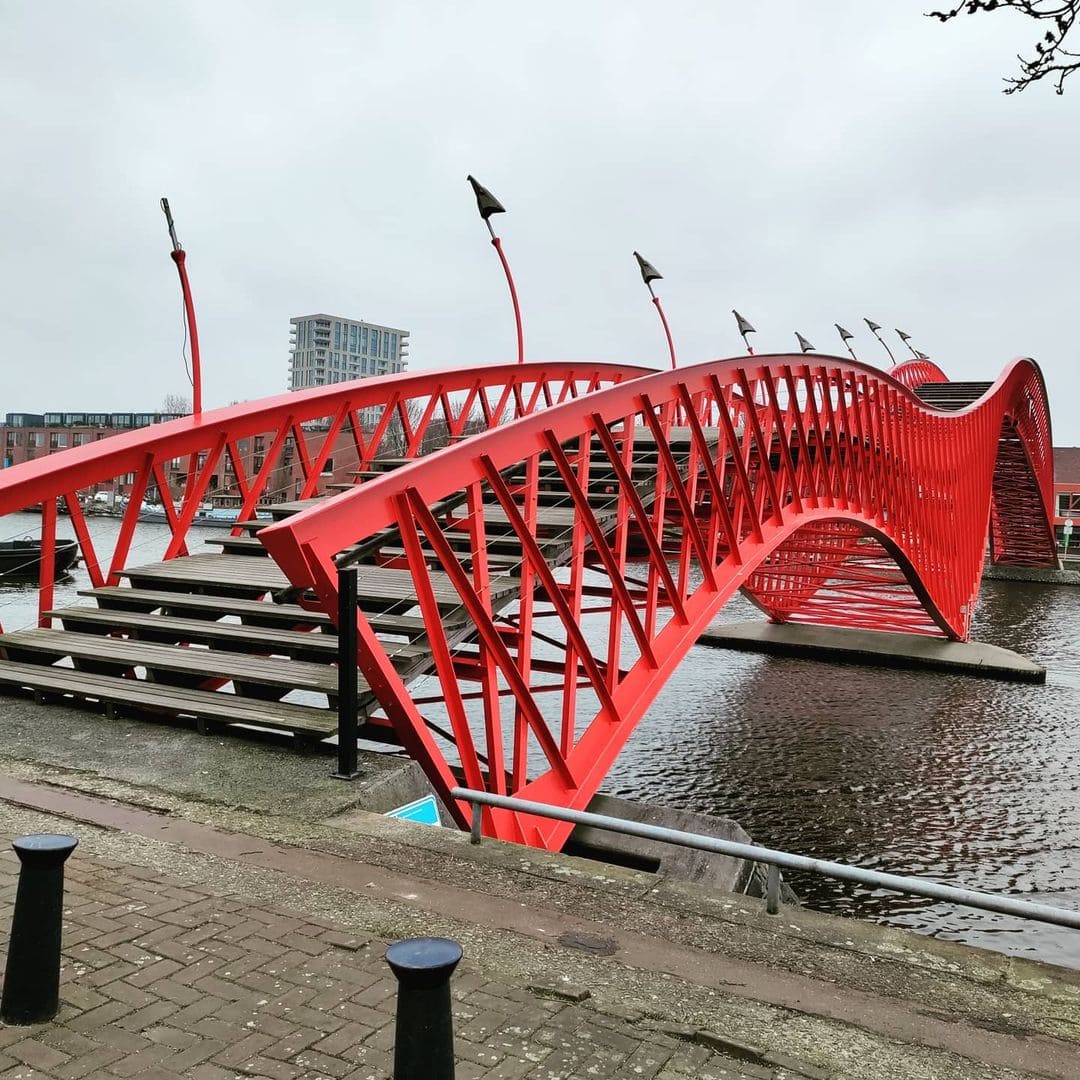
The Borneobruggen: Bridges 1997, 1998, and 1999
The Python Bridge and Its Companions in Amsterdam’s Eastern Docklands
Red, Coiling, Unmistakable
Most bridges in Amsterdam want to be unobtrusive. They are stone, or grey iron, or pale concrete. They sit in their canals and let the canal houses do the talking. The Python Bridge does not do any of this.
The Python Bridge, officially Bridge 1998 (Hoge Brug, or High Bridge) in Amsterdam’s municipal numbering system, is painted the kind of red that you see from a kilometre away. It coils across the Spoorwegbassin canal in a slow, undulating S-curve, rising steeply to a central peak before descending on the other side in an arc that is simultaneously a piece of infrastructure and a piece of outdoor sculpture. On a grey Dutch harbour morning, the red steel catches what light there is and throws it back at you. On a sunny afternoon, the shadows from the latticed steel trusses fall across the wooden deck planks in patterns that shift as you walk. The Python Bridge is, in both the casual and the precise sense of the word, a landmark.
It did not arrive alone. The Borneobruggen, the collective name for the three bridges that West 8 designed to stitch together the Borneo and Sporenburg peninsulas of Amsterdam’s Eastern Docklands, comprises Bridge 1997 (the Lage Brug, or Low Bridge), Bridge 1998 (the Pythonbrug, or High Bridge), and Bridge 1999 (the Korte Brug, or Short Bridge). Together, they form one of the most coherent and celebrated pieces of bridge design in Europe, completed in 2001 and awarded the International Footbridge Award in 2002. They are, in a working harbour district built on former industrial docks, the visual and functional connective tissue of an entirely new urban neighbourhood.
West 8 and the Eastern Docklands: A City Reimagining Itself
To understand why the Python Bridge looks the way it does, it helps to understand what it was built to connect, and what that meant for Amsterdam in the 1990s.
The Eastern Docklands (Oostelijk Havengebied) had been, for most of the late nineteenth and early twentieth centuries, the industrial engine of the port of Amsterdam. The construction of Amsterdam Centraal railway station in the 1880s had pushed the working harbour east, and Borneo and Sporenburg, the two long peninsulas that jut into the IJ, were built and operated for the loading and unloading of ships arriving from the Dutch East Indies and beyond. By the 1970s, as containerisation moved port activity to larger facilities further west, the docks emptied out. The cranes fell silent. The warehouses stood vacant. The water, which had once been alive with commercial shipping, reflected clouds and rust.
The City of Amsterdam responded with ambition. In 1993, the municipality commissioned West 8 Urban Design and Landscape Architecture, the Rotterdam firm founded by Adriaan Geuze, to produce a masterplan for Borneo and Sporenburg. What Geuze proposed was both pragmatic and philosophically charged: a high-density, low-rise residential district that would achieve a density of 100 dwelling units per hectare (three times the density of conventional suburban housing) while maintaining the intimacy and direct water access that gave the old harbour its specific character. The plan would eventually deliver 2,500 dwellings, supervised through the design process by West 8, with more than a hundred architects engaged to produce individual houses and apartment buildings.
The inspirations that Geuze cited for the plan ranged widely: the old fishing villages of the Zuiderzee, the domestic intricacy of Pieter de Hooch and Johannes Vermeer, and the dense canal-house typology of Amsterdam’s own Golden Age. His so-called “Swiss Cheese” approach dispersed open voids through the mass of solid housing, creating gardens, plazas, and water views inside what might otherwise have been an oppressive carpet of buildings. Three large apartment blocks, described by West 8 as “meteorites in a sea of houses,” punctuated the low-rise fabric at intervals: the PacMan block and the Sphinx, both set diagonally to the street grid to create visual drama and public space around their bases.
The district that resulted from this process, delivered between 1993 and 2000, is now home to approximately 6,000 residents. It has won the Veronica Rudge Green Prize in Urban Design from Harvard University’s Graduate School of Design, and is widely studied as one of the most successful examples of high-density residential waterfront regeneration attempted anywhere in Europe in the post-industrial period.
But the peninsulas needed to be connected. Borneo and Sporenburg face each other across the Spoorwegbassin canal. Without bridges, the district would have remained two separate islands of housing, each dependent on long detours via the surrounding road network. The solution West 8 proposed was not simply functional: it was monumental.
The High and the Low: Bridges 1997 and 1998
The central problem that the bridge designers faced was a classic urban engineering tension: the need to provide continuous access for pedestrians and cyclists at a practical level, while simultaneously providing sufficient clearance for the museum ships, traditional sailing vessels, and privately-owned boats that moor in the Spoorwegbassin and need to move through the basin.
The Spoorwegbassin is not a working commercial harbour, but it is a living one. Museum vessels, classic boats, and sailing craft occupy its quays and require, periodically, the ability to move. A standard flat bridge of the kind that Amsterdam uses for most of its canal crossings would have sealed the basin: tall masts and superstructures would simply not pass. A conventional bascule or swing bridge, the kind that opens for shipping on Amsterdam’s larger canals, would have required mechanical infrastructure and permanent operators. Neither option was compatible with the domestic, pedestrian-priority character of the new neighbourhood.
West 8’s answer was to build two bridges with entirely different profiles, each solving half of the problem.
Bridge 1998, the Pythonbrug (High Bridge), achieves its clearance by height. The bridge rises from both banks in a steep, S-shaped curve, reaching a maximum navigational clearance of 9.5 metres above the water surface at the centre of its 93-metre span. At this height, sailboat masts and the superstructures of museum vessels can pass freely beneath, or more precisely beneath the bridge’s lowest point over the navigable channel, without any requirement to open, swing, or move. The bridge is fixed, permanent, and structureless in the conventional sense: no counterweights, no mechanical systems, no operational crew. The clearance is built into the geometry.
The engineering implications of this geometry were, at the time of design, genuinely novel. Achieving a continuous 93-metre span with an undulating profile, rather than a conventional arch or flat girder, required the construction of a steel truss: T-profiles connected by cross-bracing, distributing loads through the curves of the structure in a way that a straight girder would distribute them along its length. The torsional forces introduced by the S-curve profile, combined with the dynamic loads of wind and pedestrian movement across a long unsupported span, demanded precise calculation. The bridge has no intermediate piers. It rises, coils, peaks, and descends entirely on the strength of its own geometry and its steel.
The deck is composed of non-slip wooden planking, laid across the steel truss frame. The wood provides warmth and texture underfoot that bare steel would not, and it weathers and ages in a way that reads as intentional rather than neglected. In photographs, the contrast between the vivid red steel and the weathered pale wood is one of the bridge’s most characteristic visual qualities.
Bridge 1997, the Lage Brug (Low Bridge), takes the other half of the brief. Where the Python Bridge rises steeply and is accessible only on foot, the Lage Brug maintains a low, gently inclined profile that cyclists, wheelchair users, and people with strollers can navigate without dismounting. It is, in formal terms, also a red steel bridge designed by West 8, and it shares the bold colouring and material language of its neighbour. But it does not undulate, and it does not rise high enough to provide ship clearance. Its function is accessibility, and it performs that function alongside the Python Bridge as a paired solution rather than a compromise.
The two bridges together constitute a complete answer to the problem: Bridge 1998 handles the navigation clearance, carrying pedestrians who do not mind stairs and are rewarded with the view from the top; Bridge 1997 handles universal access, carrying everyone else across the water at a practical level. Neither bridge, taken alone, fully solves the problem. Together, they solve it elegantly.
A Clarification for Blog Readers: Which Bridge Is Which?
A brief note for those navigating the literature: the Python Bridge is Bridge 1998 (Hoge Brug), and the low companion bridge is Bridge 1997 (Lage Brug). The numbering may initially seem intuitive, since the higher bridge carries the higher number, but this reflects Amsterdam’s geographic numbering sequence rather than any hierarchy of significance. Both carry the “1997” and “1998” designations because of their position in the city’s consecutive bridge-numbering system as it extends into the Eastern Docklands: these numbers have nothing to do with the year of construction, which was 2000-2001 for both structures.
The International Footbridge Award, 2002
The Python Bridge won the International Footbridge Award in 2002, less than a year after its completion. The International Footbridge Award is given by a jury of structural and architectural engineers to recognise outstanding achievement in pedestrian bridge design globally, and the 2002 edition recognised the Python Bridge for the combination of engineering innovation and design quality that the structure represented at the time.
What made the bridge remarkable in 2001 was not any single element but the integration of elements that are, individually, more common than their combination. The continuous unsupported span of 93 metres in an undulating profile, achieved through a truss frame rather than a conventional arch or cable system, was an engineering approach that had few precedents at this scale. The vivid red paint, applied to an industrial-harbour location in a way that read as celebration rather than warning, was a design decision that ran against the understated aesthetic norms of Dutch engineering infrastructure. The decision to make a pedestrian bridge the most visible landmark in an entire new residential district, rather than subordinating it to the housing behind it, reflected a conviction about the role of public infrastructure in shaping urban identity.
The award committee recognised all of this. The International Footbridge Award has since become one of the more significant markers of achievement in pedestrian bridge design internationally, with winners in subsequent years including structures in London, Paris, and Lisbon. The Python Bridge’s 2002 victory placed it at the beginning of a period in which pedestrian bridges were increasingly understood as objects of design ambition rather than mere functional connectors, and the Western Docklands commission can be read, in retrospect, as an early and decisive statement of what that ambition could look like in practice.
The bridge appeared on Architectural Digest’s list of the 18 most beautiful bridges in the world in 2019, nearly two decades after its completion: a recognition that its status as a design object had not faded with time.
The Third Bridge: Brug 1999, the Korte Brug
Visitors who arrive at the Borneobruggen prepared for two bridges sometimes discover a third. Bridge 1999, the Korte Brug (Short Bridge), is the third member of the West 8 trio, a smaller span that completes the connectivity of the complex. Where Bridges 1997 and 1998 cross the main channel of the Spoorwegbassin in parallel, Bridge 1999 provides a shorter connection at a different point in the system, completing the pedestrian and cyclist network that West 8 envisaged for the junction between the two peninsulas.
The Korte Brug is less celebrated than its companions: it does not undulate, it does not rise 9.5 metres above the water, and it does not have a name derived from a large reptile. But for residents making daily trips across the water, it is a practical and appreciated piece of the network, and for bridge spotters visiting the Eastern Docklands, finding all three of the Borneobruggen constitutes a minor but satisfying completion.
Standing at the Peak: What You See
The Python Bridge’s central summit is, by some margin, the most dramatic public viewpoint in Amsterdam’s Eastern Docklands. The climb to the top is steep and stepped: the bridge is not designed for casual ambling, and the stairs on both approaches are real stairs, at a real gradient, requiring a real exertion. This is not a bridge for cyclists, strollers, or those with limited mobility (all of whom should use Bridge 1997, the Lage Brug, immediately adjacent).
For those who do make the climb, the reward is considerable. From the peak, the Spoorwegbassin opens below in both directions, with the quays of Sporenburg to the south and the quays of Borneo Island to the north. The Stuurmankade and the Panamakade, the streets that the bridge connects at its two ends, frame the view. Further north, across the basin, the IJ waterway is visible, and beyond it the NDSM wharf and the northern bank of Amsterdam’s harbour.
Looking west from the peak, the silhouette of the Het Scheepvaartmuseum (the National Maritime Museum) is visible in the distance, its classical facade marking the edge of the old harbour district. Museum ships, moored in the basin between the museum and the Eastern Docklands, explain the navigational clearance that the Python Bridge was required to achieve: tall-masted vessels, historic sailing ships, and the kind of large-format museum craft that requires 9 metres or more of clearance to move freely. The bridge was not simply designed to look dramatic. It was designed to let these vessels breathe.
Looking east, the residential fabric of Borneo and Sporenburg spreads out in both directions: the three-story canal houses in their dozens of individual architectural variations, the interrupting bulk of the “meteorite” apartment buildings, the water channels between the housing blocks. From this height, West 8’s masterplan becomes legible as a plan rather than a street: the density, the interspersed voids, the relationship between the housing and the water all readable from an elevation that the flat streets below cannot provide.
The Red and Its Maintenance
The red is not incidental. West 8’s decision to paint the Borneobruggen in a single, saturated red was a deliberate act of urban marking: a signal that these bridges are not infrastructure in the background sense but objects of interest, waypoints, landmarks. The colour functions like a harbour buoy, pulling attention across the water, and it connects the bridge visually to the industrial maritime history of the docklands in which it stands, where red and black were the standard colours of working marine equipment.
Maintaining that red in a harbour environment is an ongoing commitment. Salt air, wind-driven moisture, and the thermal cycling of exposed steel in a coastal climate conspire steadily against painted surfaces, and the vivid saturated red that photographs so dramatically on a bright day can fade or corrugate in ways that are visible on the long steel spans of a bridge of this size. Amsterdam’s municipal bridge maintenance programme, which covers approximately 1,900 structures across the city under a rolling 2020-2040 inspection and renewal schedule, includes the Borneobruggen within its scope.
Specific repainting intervals and most recent maintenance works for Bridge 1998 are not publicly recorded in accessible online sources; for current maintenance status, the Gemeente Amsterdam’s Dienst Verkeer en Openbare Ruimte (Department of Traffic and Public Space) holds the relevant records. What can be said is that the vivid red visible on the bridge today is the product of periodic intervention, and that the bridge’s status as a recognised municipal monument and international design landmark means that its cosmetic and structural maintenance is taken seriously by the city.
The Neighbourhood That Grew Around Them
When the Python Bridge opened in April 2001, the Borneo-Sporenburg district was still being completed around it. The 2,500 dwellings of West 8’s masterplan were delivered between 1993 and 2000, and the bridges were among the last elements of the programme to be finished. In the years since, the neighbourhood has settled into the kind of residential confidence that comes from being well-designed and well-used: the cafes and boutiques and boat-filled canals of the Eastern Docklands draw a steady stream of visitors who come not for a specific attraction but for the pleasure of the environment itself.
The Borneo-Sporenburg project is now studied in architecture schools across the world as a model for high-density waterfront regeneration. Its particular achievement, the combination of high density (100 dwellings per hectare) with low rise (three storeys maximum), direct water access, and diverse architectural expression under a coherent masterplan, has been replicated in various forms in harbour districts from Hamburg to Melbourne. The Python Bridge, which appears in practically every survey of the project, has become a kind of logo for the whole enterprise: the most immediately recognisable element of a district that is, in its totality, one of the more ambitious pieces of urban design produced in the Netherlands in the twentieth century’s final decade.
The bridge is free to cross, open at all times, and requires nothing from its visitors except the willingness to climb. On a clear day, from its steel peak, you can see where the city came from, and the direction it decided to go.
Research compiled February 2026. Principal sources consulted include: the Dutch Wikipedia article on the Pythonbrug (nl.wikipedia.org/wiki/Pythonbrug); the West 8 project page for Borneo-Sporenburg (west8.com/projects/borneo-sporenburg); the Harvard University Graduate School of Design Urban Design Case Study archive on Borneo-Sporenburg (udcsa.gsd.harvard.edu); Archello project record for Borneo-Sporenburg (archello.com); MVRDV project records for Borneo 12 and Borneo 18 (mvrdv.com); Gemeente Amsterdam bridge maintenance programme records (amsterdam.nl/projecten/bruggen); the Architectural Digest 2019 list of the world’s most beautiful bridges; and the Bridges of Amsterdam archive (bridges.cramberts.com). Engineering specifications confirmed through the Creative Composites Group architectural reference and Grokipedia entry for the Python Bridge.
Key Facts at a Glance
Collective name: Borneobruggen Bridges: 1997 (Lage Brug / Low Bridge), 1998 (Pythonbrug / Hoge Brug / High Bridge), 1999 (Korte Brug / Short Bridge) Location: Spoorwegbassin canal, Eastern Docklands (Oostelijk Havengebied), Amsterdam-Oost; connecting Panamakade (Sporenburg peninsula, south) to Stuurmankade (Borneo Island, north) Designer: Adriaan Geuze / West 8 Urban Design and Landscape Architecture, Rotterdam Completed: 2001 (all three bridges) Official opening: 10 April 2001
Bridge 1998 (Pythonbrug / Hoge Brug):
- Type: Fixed truss bridge (steel T-profiles with cross-bracing)
- Span: 93 metres (continuous, unsupported)
- Maximum navigational clearance: 9.5 metres
- Deck: Non-slip wooden planking over steel frame
- Colour: Vivid red (painted steel)
- Access: Pedestrians only; stairs at both approaches; not suitable for cyclists, wheelchairs, or strollers
- View from peak: Eastern Docklands, IJ waterway, Het Scheepvaartmuseum to the west, museum ships in the basin
Bridge 1997 (Lage Brug / Low Bridge):
- Type: Fixed low-profile steel bridge
- Access: Cyclists, wheelchair users, pedestrians, strollers
- Colour: Red (matching Bridge 1998)
- Function: Provides universal-access crossing complementing the high pedestrian span of Bridge 1998
Bridge 1999 (Korte Brug / Short Bridge):
- Third bridge of the West 8 Borneobruggen trio
- Shorter span; completes the pedestrian and cyclist connectivity of the complex
Awards and recognition:
- International Footbridge Award, 2002
- Veronica Rudge Green Prize in Urban Design (Harvard GSD), awarded to the Borneo-Sporenburg masterplan
- Architectural Digest, “18 Most Beautiful Bridges in the World,” 2019
Urban context: Part of the Borneo-Sporenburg masterplan (West 8, 1993-2000); 2,500 dwellings at 100 units/hectare; approximately 6,000 residents; considered the most densely populated low-rise residential district in the Netherlands; former industrial harbour transformed into residential waterfront Note on bridge numbering: The numbers 1997 and 1998 are Amsterdam municipal bridge numbers, not years of construction. The bridges were built in 2000-2001.
Location:
The Python Bridge is situated in the Eastern Docklands (Oostelijke Eilanden) area of Amsterdam. It spans over the Oosterdokseiland and connects the Kattenburgerstraat on the Eastern Docklands side to the Oosterdokskade on the city centre side.
Design:
The bridge is a striking and innovative piece of architecture designed by the firm West 8. It features a distinctive red color and a curvy, serpentine shape, resembling the shape of a python, which gives it its popular nickname. The design is eye-catching and has made the bridge a recognisable landmark in the area.
Pedestrian-Friendly:
As a pedestrian bridge, The Python Bridge is exclusively for foot traffic and bicycles. It provides a safe and convenient way for pedestrians and cyclists to cross the Oosterdok and access different parts of the city, including the city centre and the Eastern Docklands.
Height:
The bridge stands at a considerable height above the water, allowing for large boats and ships to pass underneath without any obstruction. This height also offers pedestrians and cyclists a unique vantage point to enjoy scenic views of the surrounding area and the Amsterdam waterfront.
Part of Urban Redevelopment:
The Python Bridge is not only a functional structure but also an integral part of the urban redevelopment project in the Eastern Docklands. This area has undergone significant transformation in recent years, with various modern buildings, residential areas, and cultural spaces contributing to the revitalisation of the former industrial port area.
Opening:
The Python Bridge was officially opened to the public on April 10, 2001. Since then, it has become a popular route for locals and tourists alike, providing an enjoyable and visually appealing experience while crossing the water.
Originally posted on Instagram @8lettersuk as part of a lockdown project.
Borneobruggen – Bridges 1997 & 1998 | Amsterdam
The Python Bridge, officially known as High Bridge (Hoge Brug), is (bridge number 1998) and is a pedestrian bridge in Amsterdam. It’s part of a pair of bridges called the High and Low Bridges (Lage Brug 1997) or the Borneo bridges that connect the Panama quay on the peninsula Sporenburg with Borneo Island.
The bridges were completed in 2001 in spite of the name plates saying anno 2000!