The Number That Moved: Brug 85, a Footbridge and a Tram Viaduct
Brug 85 is two different bridges, in two different parts of Amsterdam, separated by thirty-five years and a filled-in canal. It is the clearest case in this series of a bridge number outliving the bridge it was issued to.
The First Brug 85: An Iron Footbridge, 1883
The original was an iron pedestrian bridge, opened in May 1883, carrying the line of the Derde Weteringdwarsstraat across the Vijzelgracht.
As with several bridges of the period, the design is unattributed. The city architect Bastiaan de Greef and his assistant Willem Springer were responsible for most municipal bridge work in these years, and the drawings are consistent with their hand, but nothing on them says so.
It was a footbridge, which in Amsterdam usually means a crossing built because people were already crossing there.
It lasted about fifty years. When the Vijzelgracht was filled in during 1933, the bridge lost its reason to exist and disappeared around 1934, in the same clearance that took away Brug 83 and the two crossings over the Nieuwe Looiersgracht.
The Second Brug 85: A Tram Viaduct, 1969
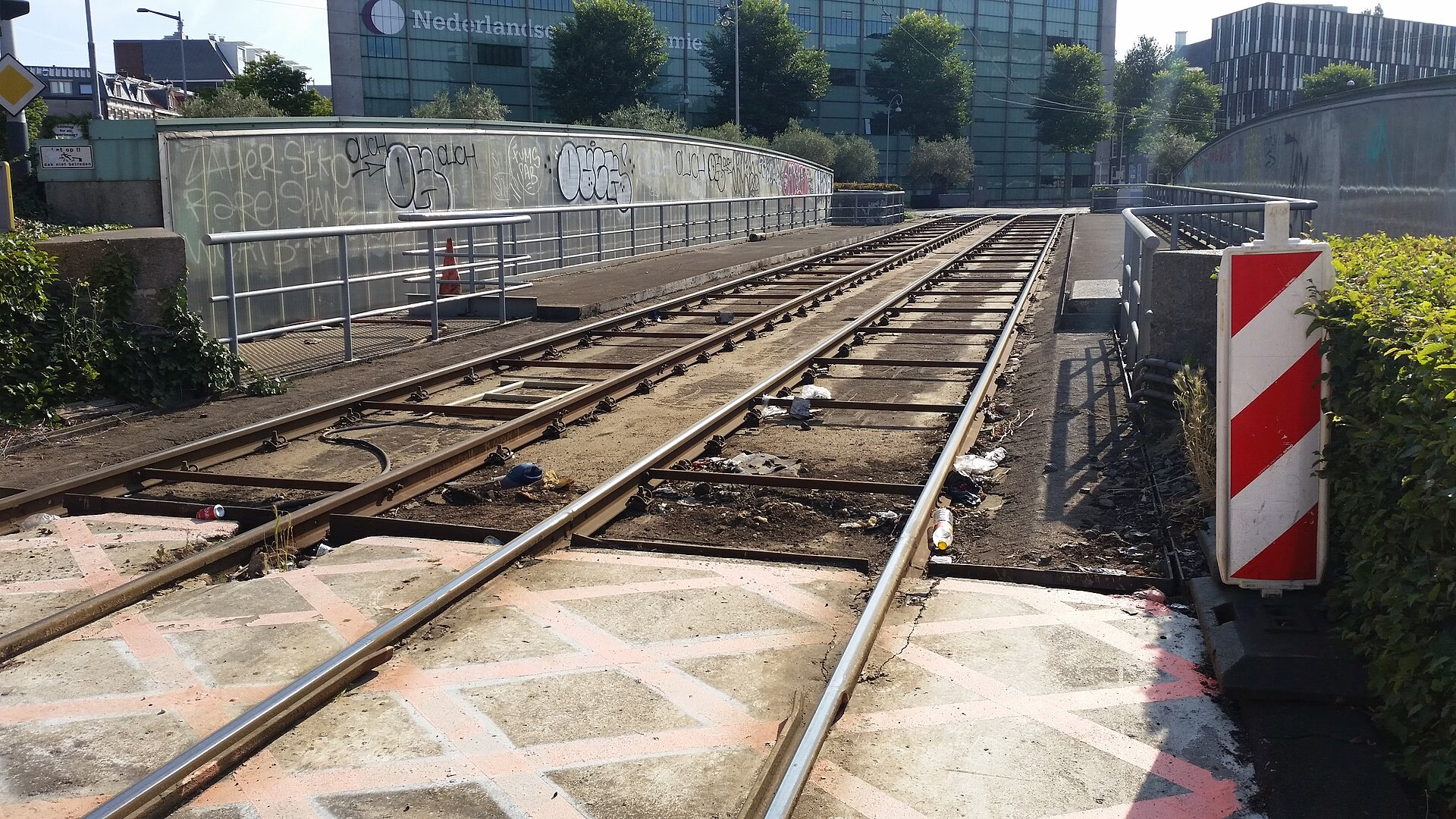
The number reappears in September 1969, on the other side of the centre, attached to something entirely different: a steel tram viaduct at the Mr. Visserplein, carrying tram line 9 over a road tunnel. Tram line 14 was added in 1982.
The bridge alone weighed about 34 tonnes.
The Mr. Visserplein of 1969 was the product of the most aggressive phase of Amsterdam traffic planning. It was also built on ground that had been cleared by genocide.
This was the heart of the Jodenbuurt, the Jewish quarter, lived in continuously since the seventeenth century. In 1941 roughly 80,000 Jews lived in Amsterdam. Around 60,000 of them were murdered. The Netherlands lost about three quarters of its Jewish population, the highest proportion anywhere in Western Europe.
They were taken from these streets. The Hollandsche Schouwburg on the Plantage Middenlaan, five minutes east of here, was the assembly point from 1942; the creche opposite held the children. From there people went to Westerbork, and from Westerbork to Auschwitz and Sobibor. The round-ups were carried out by the German occupier with the substantial assistance of the Amsterdam municipal police.
The demolition came afterwards, and because of it. The houses stood empty because their inhabitants had been killed. During the Hongerwinter of 1944 to 1945 the abandoned quarter was stripped for fuel, beams, floors, staircases and door frames pulled out of buildings by people freezing elsewhere in the city, and much of what was left was structurally ruined. The city cleared the remains through the 1950s and 1960s and treated the result as available land.
That is the ground this viaduct stands on. The road scheme, with tunnels beneath and trams carried above on structures like this one, was laid across a neighbourhood that had been emptied of its people and then of its buildings.
The square itself records part of it. It was named in 1968 for Lodewijk Ernst Visser (1871 to 1942), president of the Hoge Raad, the Dutch Supreme Court, who was dismissed from office in November 1940 because he was Jewish. He refused to accept the occupier’s authority to remove him, refused to deal with the Jewish Council on the grounds that it lent legitimacy to what was being done, and campaigned against it until his death in February 1942.
Why It Did Not Work
The arrangement failed on its own terms, and the reason is human nature.
Separating trams from cars is efficient on paper. In practice it meant tram passengers had to reach their stops through underground passages, and people would not do it. The stops were inconvenient, they felt unsafe, and usage fell.
In 1985 the tram stops were moved to the Muiderstraat. The pedestrian tunnels beneath closed in 1996.
It is a small monument to a way of thinking about cities that Amsterdam has spent the last forty years dismantling. Not far from here, the seven bridges of the Reguliersgracht survive precisely because nobody was allowed to apply this logic to them.
One Number, Two Bridges, and What That Tells You
The reassignment is unusual. Amsterdam generally leaves a number vacant when a bridge goes, which is why 33 and 83 are empty. Here the number was reused for an unrelated structure in an unrelated place.
Anyone searching the archives for Brug 85 will therefore find two bridges with nothing in common: an iron footbridge over a canal that no longer exists, and a steel viaduct over a tunnel. The bridge index lists the surviving one.
The Riots That Ended the Plan
Brug 85 belongs to a scheme that Amsterdam abandoned, and it was abandoned in the street nearby.
The metro and road works that produced this viaduct were part of a larger design: an Oostlijn metro driven through the old city, and a four-lane motorway to follow it through the Nieuwmarkt district. Building it meant demolishing sound housing on a large scale, because the tunnel was assembled from concrete caissons cast above ground and then sunk, which required clearing everything above the line. Much of the Lastage, between the Geldersekade and the Oudeschans, came down.
On 24 March and 8 April 1975 the evictions were fought. The Nieuwmarktrellen, the Nieuwmarkt riots, were among the most serious civil disturbances in post-war Amsterdam.
The metro line was finished. Almost nothing else was. The city withdrew the Metroplan, dropped the further lines, abandoned the motorway, and rebuilt the Nieuwmarkt on the old property boundaries rather than the new plan. The governing idea shifted to small-scale development, building for the neighbourhood, and the compact city.
That is the context for a 34-tonne tram viaduct whose stops nobody wanted to use. It is a surviving fragment of the last Amsterdam scheme that put moving vehicles ahead of living in the city, built in the same years the argument was lost.
The Nieuwmarkt metro station, opened in 1980, carries five artworks commemorating what happened to get it built.
Living in the area since my move to Amsterdam I have to say the one thing I wish they had done when the plan failed was bury the Valkenburgerstraat to the Nemo and the Ij Tunnel. Imagine that space as a park leading from the city centre to the historic maritime areas of the Oosterdok area.
Technical Specifications
- Bridge number: 85
- Current structure: Trambrug (tram viaduct), September 1969
- Carries: Tram line 9, joined by line 14 in 1982
- Spans: The road tunnel at Mr. Visserplein
- Material: Steel
- Weight: Approximately 34 tonnes
- Coordinates: 52.3681 N, 4.9041 E
- Earlier structure: Iron pedestrian bridge, May 1883
- Earlier location: Derde Weteringdwarsstraat over the Vijzelgracht
- Earlier bridge lost: Around 1934, after the Vijzelgracht was filled in 1933
- Tram stops relocated: 1985, to the Muiderstraat
- Tunnels closed: 1996
- Status: Not a monument
Sources Consulted
- Featured image: Brug 85, Bridge 85, Amsterdam by Ceescamel, 2018, via Wikimedia Commons, CC BY-SA 4.0
- Brug 85, Nederlandstalige Wikipedia
- Vijzelgracht, Nederlandstalige Wikipedia
- Mr. Visserplein, Nederlandstalige Wikipedia
- Joods Cultureel Kwartier, including the Hollandsche Schouwburg and the Nationaal Holocaustmuseum
- Joods Monument, the record of Dutch Jews murdered in the Holocaust, searchable by address
- NIOD Instituut voor Oorlogs-, Holocaust- en Genocidestudies
- Jodenbuurt, Amsterdam, Nederlandstalige Wikipedia
- Lodewijk Ernst Visser, Nederlandstalige Wikipedia
- Bruggen van Amsterdam
- Stadsarchief Amsterdam, Beeldbank and Publieke Werken archives
- Frank V. Smit, Bruggen in Amsterdam (2008), Uitgeverij Matrijs